In short
- Compact is the simple answer for showers and changing rooms: the industry guidance rates it suitable for the wettest zone, with no protection needed for cut edges or openings.
- HPL on a board works in dry rooms and splash zones with protected edges, but in wet rooms only plywood to EN 636-3, with special edge protection, is recommended.
- Use D3/D4 water-resistant glue lines, ventilate wall panels with a 24–30 mm gap and seal the joints. Rushil's interior compact gains just 0.4 % mass in boiling water, against a permitted 2 %.
How this guide was put together
This article draws on proHPL's technical leaflets 'Anwendung von HPL in Feucht- und Nassräumen' (April 2017), 'Wandbekleidungen mit HPL für den Innenbereich' (March 2015) and 'Verarbeitung von HPL-Compact' (February 2021). proHPL is the decorative laminates group of the German plastics industry association pro-K. Each point is attributed, and the sources are listed at the end.
Three kinds of wet
proHPL sorts the spaces by the German standard DIN 68800. Dry rooms (2a) include all living spaces, kitchens and private bathrooms. Wet areas (2b) are surfaces exposed to splash and surge water, even inside dry rooms — a shower wall, for example. Damp and wet rooms (2c) have lasting high humidity or heavier exposure to water, as in baths, spas and thermal baths.
Compact: the simple answer
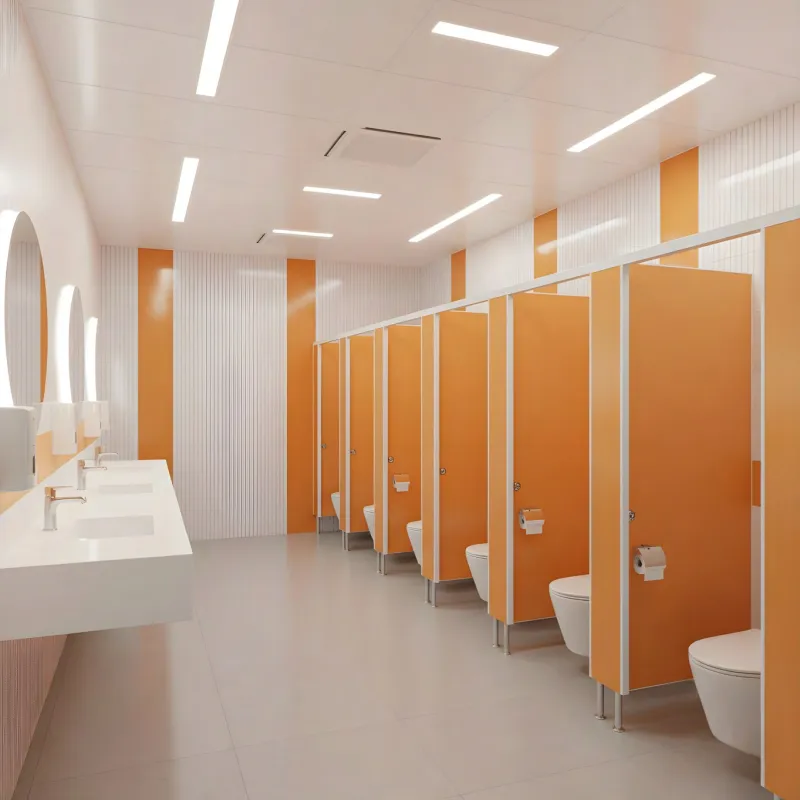
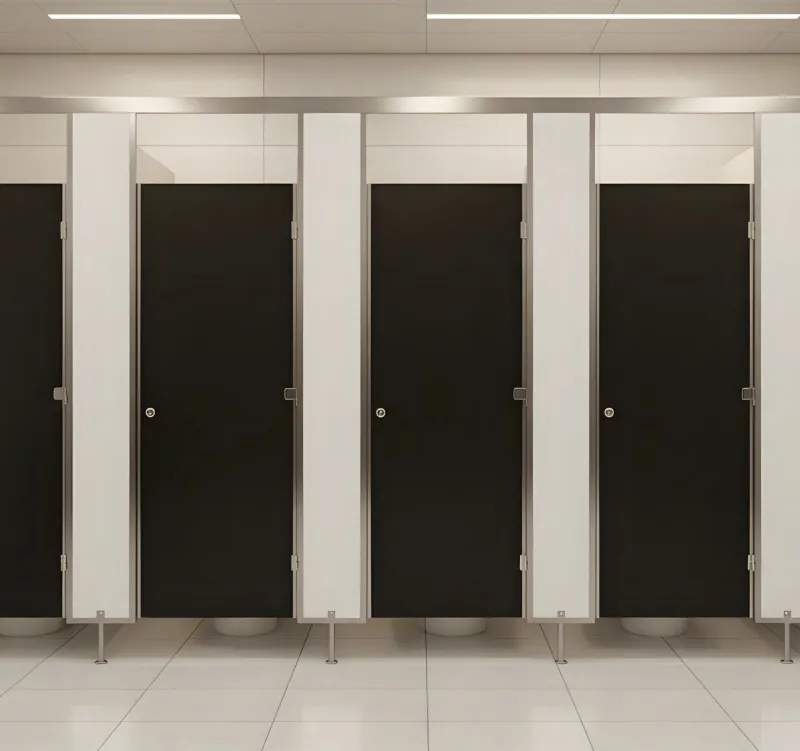
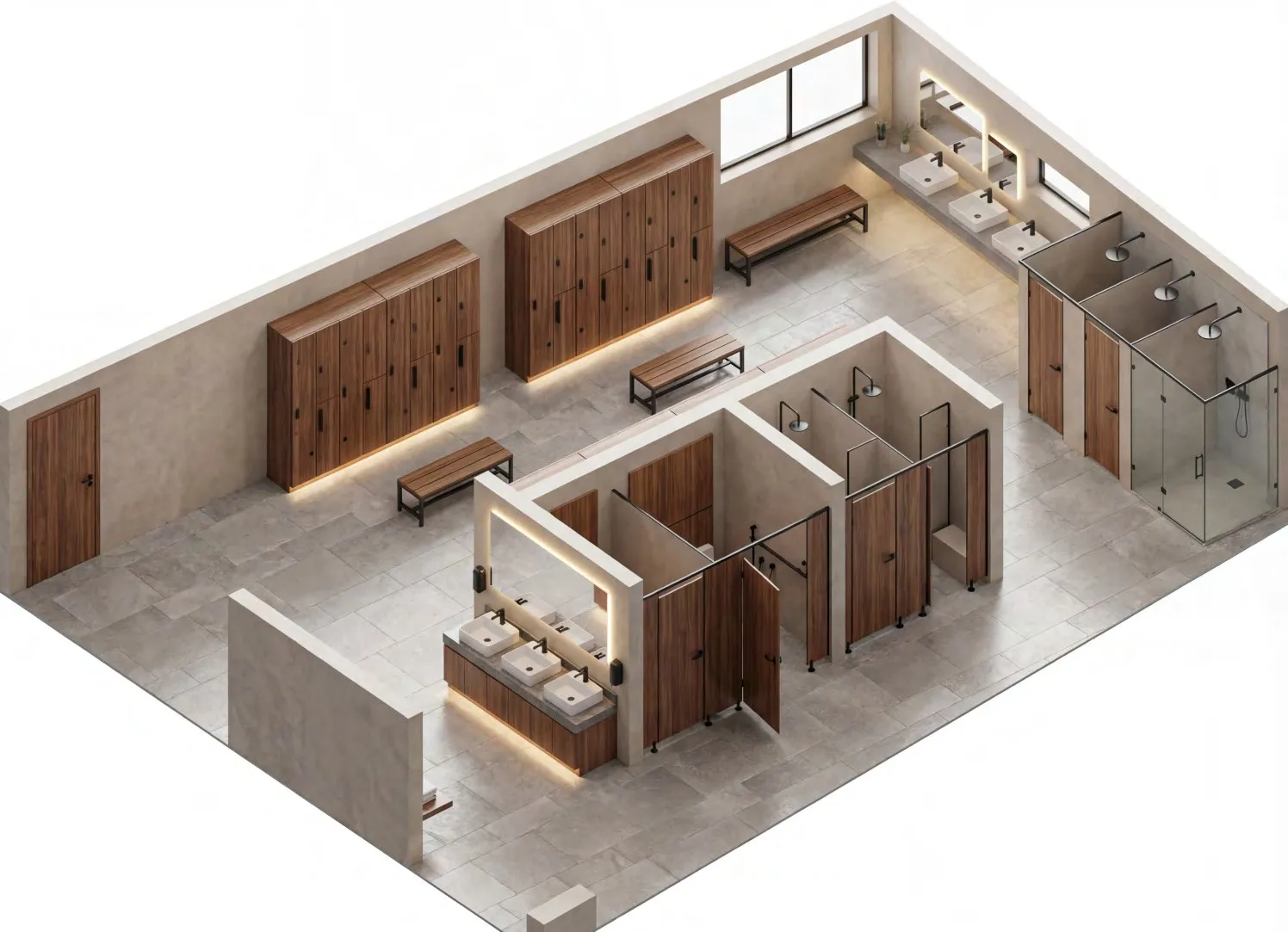
Because of its high water resistance, compact is particularly suited to the hardest zone, 2c, proHPL writes: cut edges and openings need no protection. It names wall cladding (CE marking applies), shower partitions, changing cubicles and vanity tops as typical uses.
HPL on a board: it depends on the core
For HPL bonded to a board, the leaflet's table is clear. In dry rooms and in splash zones, chipboard (P2 or P5), plywood, blockboard, hardboard and MDF are all suitable with edge protection. In damp and wet rooms none of them is recommended, with one exception: plywood to EN 636-3, and only with special edge protection.
The reason is the board, not the laminate. Wood-based boards react to water and humidity much as solid wood does; even boards with increased moisture resistance swell when wet, up to destruction, and steam and humidity change their size without direct contact. In splash zones, every edge, joint, opening and fixing has to be protected against water.
Glue lines and edges
For wet areas, proHPL recommends adhesives that give a water-resistant glue line, D3/D4 to EN 204. Melamine-urea and phenol-resorcinol resins, reactive adhesives such as epoxy, unsaturated polyester and polyurethane, and PUR hot melts are listed for all three zones; standard PVAc for dry rooms only; EVA and polyolefin hot melts for none.
Edge protection must go all round the workpiece, because water reaches the core only through the joint between laminate and edge. Standard protection means edges of HPL, polyester, ABS, PVC, PP or melamine; the special kind adds sealing lacquers, sealed 5 mm hardwood lippings, inserts of compact HPL, casting resins or sealants.
Walls, floors, joints and screws
Wall panels need ventilation behind them so that both faces stay in the same climate: the wall-cladding leaflet asks for an air gap of generally 24–30 mm, on vertical or interrupted horizontal battens no more than 600 mm apart for panels up to 12 mm thick and 800 mm for thicker ones. In a dry-lining renovation, existing tiles can stay on the wall. At the floor, panels on a board core need a drip edge and sealed cut faces; proHPL recommends at least 100 mm of floor clearance, with compact as the plinth in wet areas.
Joints in wet zones are sealed — for example 5 mm wide, with a backing cord and silicone on degreased and primed surfaces; between compact panels a strip of HPL behind the joint is enough. Screws into compact need a pre-drilled hole one thread depth smaller than the screw and at least 1 mm deeper than its penetration. Large panels can cut the length of joints by up to 90 % compared with tiles, which proHPL counts as a hygiene advantage.
Reading this against the Rushil range
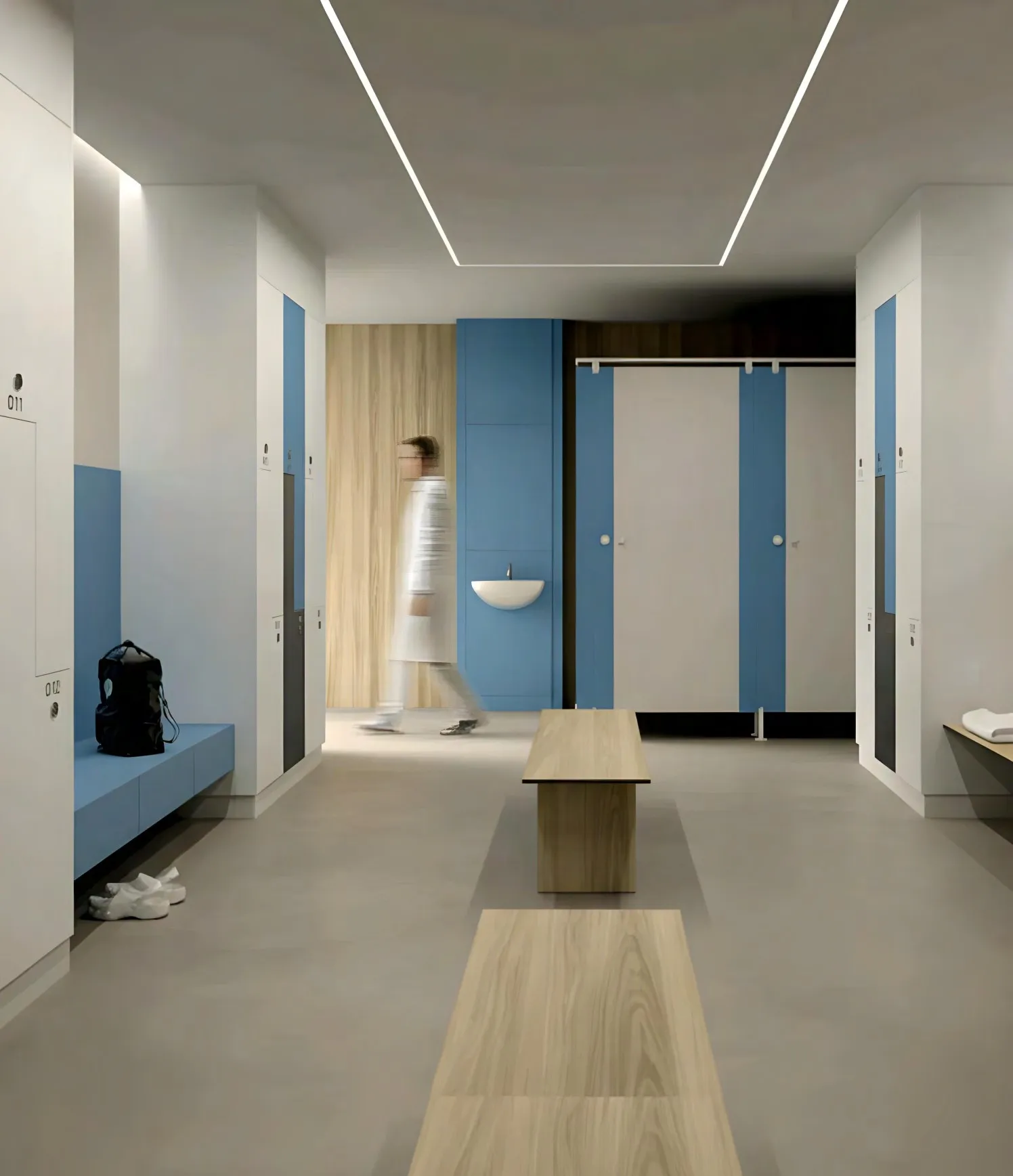
Rushil's VAULT is a compact panel system for cubicles, partitions and lockers. Its data sheet reports, to EN 438-2, a mass increase of 0.4 % in boiling water (permitted: 2 %), grade 5 for resistance to water vapour (required: 4), and dimensional changes of 0.1 % lengthwise and 0.08 % crosswise (permitted: 0.3 % and 0.6 %). For cleaning in wet rooms, proHPL's advice is the general one: mild cleaners, limescale with warm dilute acetic or citric acid, and descalers and toilet cleaners rinsed off at once.
Common questions
Can HPL be used in a shower?
Yes — as compact, or as HPL on a suitable core with protected edges. proHPL rates compact suitable for the wettest zone without edge protection; HPL on chipboard or MDF is not recommended there.
Which glue should be used for HPL in a bathroom?
One that gives a water-resistant glue line, D3/D4 to EN 204: for example melamine-urea or phenol-resorcinol resins, epoxy or polyurethane reactive adhesives, or PUR hot melts (proHPL).
Can HPL wall panels go over old tiles?
Yes. In a dry-lining renovation, proHPL says existing tiles can stay on the wall, provided the panels are ventilated behind — generally a 24–30 mm gap on vertical or interrupted horizontal battens.
Sources
- proHPL (pro-K) — Anwendung von HPL in Feucht- und NassräumenApril 2017 · de
- proHPL (pro-K) — Wandbekleidungen mit HPL für den InnenbereichMarch 2015 · de
- proHPL (pro-K) — Verarbeitung von HPL-CompactFebruary 2021 · de
Compiled for this site from the publications listed above. Summaries are in our own words, not quotations — read the originals for the full argument.