In short
- HPL is 50–70 % paper and 30–50 % thermosetting resin: phenol-impregnated kraft papers form the core, and a melamine-impregnated decor paper of 50–160 g/m², plain or printed, forms the surface.
- The stack is cured at more than 120 °C under 5–8 MPa — hence 'high-pressure' — in cycles of up to 100 minutes; thin sheets are 0.5–1.9 mm, compact from 2 mm upward.
- Rushil makes decorative HPL (0.5–1.8 mm), interior compact and KLADS exterior compact, all classified to EN 438 and made in Gujarat under ISO 9001, 14001 and 45001.
How this guide was put together
This guide follows the technical leaflet on HPL manufacture published by the ICDLI, the association of European laminate manufacturers, with its 2026 white paper and a Fraunhofer study for the make-up of the material, and Rushil's own data sheets for how its products are built.
From Bakelite to compact
The ICDLI traces HPL to 1907, when the Belgian chemist Leo Baekeland patented Bakelite, a phenolic resin cured by heat. Paper impregnated with phenolic resin and cured between steel plates became the carrier for electrical components in the radios of the 1920s. Melamine resins were made commercially from the 1930s and decorative papers able to absorb them followed in the 1940s; laminates with a phenolic kraft core under a coloured melamine surface developed rapidly in the 1950s.
Self-supporting compact laminate and postforming grades came in the 1960s, fire-retardant grades in the 1970s, exterior compact with weather-resistant surfaces in the 1980s, continuous presses in the 1990s, digital decor printing in the 2000s and antibacterial surfaces in the 2010s.
Paper and resin
HPL is 50 to 70 % paper and 30 to 50 % thermosetting resin by weight. The ICDLI lists three papers: saturating kraft paper of 80 to 300 g/m², from virgin or recycled fibre, for the core; a decor paper of 50 to 160 g/m², pigmented in a solid colour or printed with wood, stone or other designs; and, where extra abrasion resistance is wanted, a transparent overlay paper of 15 to 80 g/m².
Two resins bind them. Phenolic resin, brownish and relatively elastic, goes into the kraft core. Melamine resin, transparent, lightfast, hard and scratch-resistant, goes into the decor and overlay papers and forms the surface. Both are made in batch reactors from formaldehyde with phenol or melamine.
Impregnating and assembling
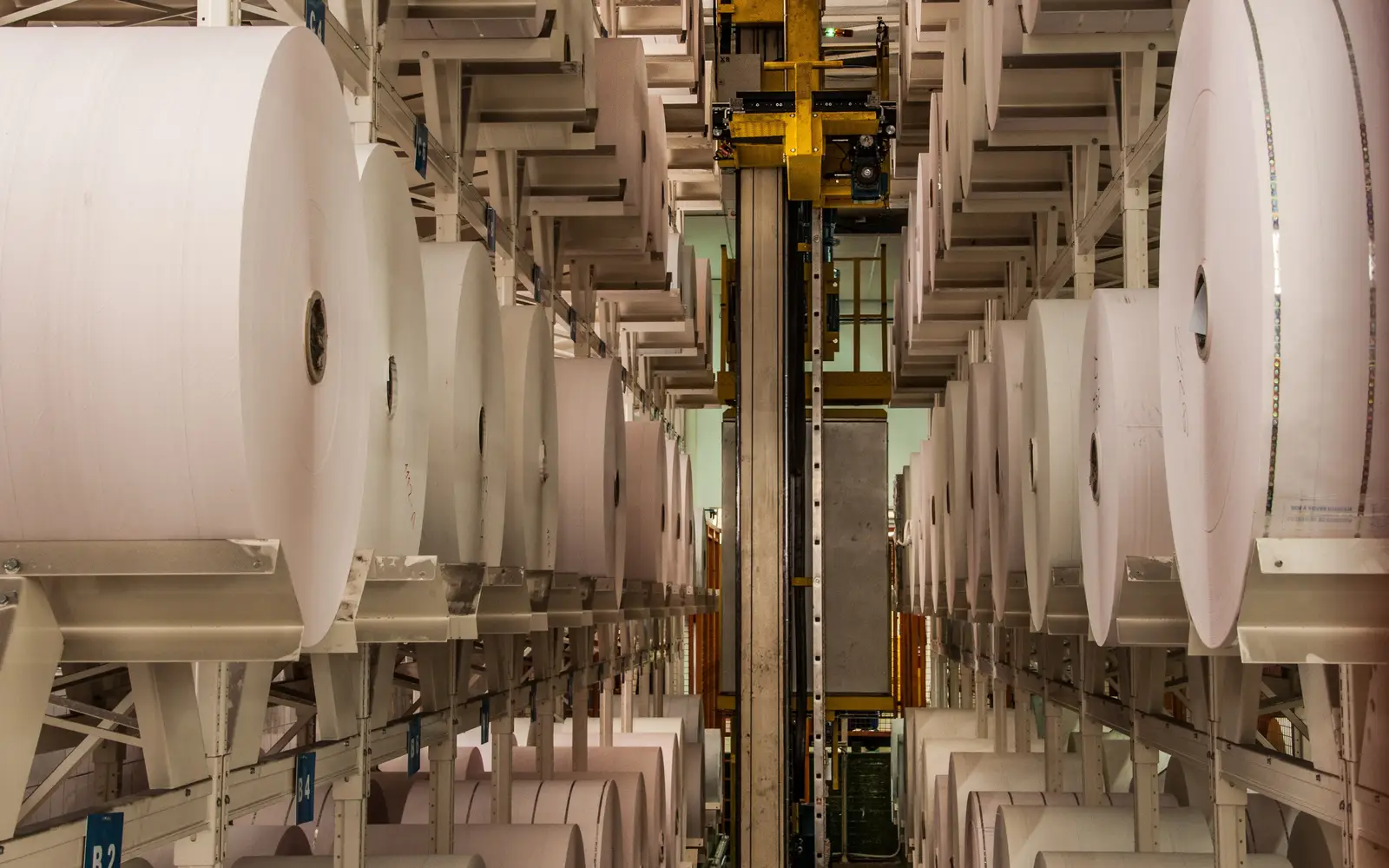
The papers arrive in large rolls. In a continuous treater each web is unwound, drawn through a resin bath, saturated and dried; the dry paper, still carrying reactive resin, is cut into sheets or rewound and stored in conditioned rooms. The sheets are then laid up in a clean, dust-free room in the order the product needs: decor paper, with overlay where required, over a few kraft sheets for a thin laminate, and over many more for a compact panel.
In a multi-daylight press, the ICDLI writes, presses with up to 45 openings are in use, each filled with up to 24 thin laminates, usually 0.5 to 1.9 mm thick, or with at least one compact laminate, usually 2 to 20 mm.
Heat, pressure and cure
The press is closed, put under a hydraulic pressure of 5 to 8 MPa and heated to more than 120 °C; EN 438 gives at least 120 °C and 5 MPa as typical values for the high-pressure process, hence the name. The resins melt and are forced between and into the cellulose fibres, the material densifies and the chemical reaction completes. The result, in the ICDLI's words, is a homogeneous, rigid, fully cross-linked sheet that is non-porous and will not melt, with the fibres chemically bonded into it. The press plate gives the surface its finish, from high gloss to matt or textured, and the sheets are cooled under pressure to release tension. A full cycle can take up to 100 minutes.
Thin laminates can also be made on continuous presses between two steel belts, at 8 to 25 m/min for sheets of 0.5 to 1.0 mm. Afterwards the sheets are trimmed to size, thin laminates are sanded on the back so that they glue well, and the sheets are inspected for surface defects before they are labelled and packed.
How Rushil's products are built
Rushil's range follows this build-up. Decorative HPL, 0.5 to 1.8 mm thick, is made from phenol-impregnated kraft papers and a melamine-impregnated decor paper, in horizontal and vertical general-purpose grades, HGS and VGS. TOPAZ and VAULT compact are pressed from many layers of phenolic kraft and decor paper with melamine resin and protected by a melamine-impregnated overlay, in standard and fire-retardant grades, CGS and CGF. KLADS, the exterior compact, has a phenolic kraft core in brown or black under a décor paper protected by a UV film more than 50 µm thick, in standard and fire-retardant exterior grades, EDS and EDF.
Every one is classified to EN 438 and tested to EN 438-2, and made in Gujarat under management systems certified to ISO 9001, ISO 14001 and ISO 45001, with FSC and PEFC chain-of-custody certification for certified laminates. Data sheets and samples are available on request.
Common questions
What is HPL made of?
Paper and thermosetting resin, with paper making up 50 to 70 % of the weight. Kraft papers impregnated with phenolic resin form the core; a decor paper impregnated with melamine resin, sometimes under a transparent overlay, forms the surface.
Why is it called high-pressure laminate?
Because it is cured under high pressure and heat. EN 438 gives at least 120 °C and 5 MPa as typical values, and the ICDLI describes multi-daylight presses working at 5 to 8 MPa and above 120 °C.
What is the difference between thin HPL and compact?
The number of kraft layers. Thin laminates, usually 0.5 to 1.9 mm, are glued to a board; compact laminates, from 2 mm upward, are thick enough to carry themselves.
Sources
- ICDLI — International Committee of the Decorative Laminates Industry — An Introduction to Manufacturing and Material Types (technical leaflet)July 2015 · en
- ICDLI — International Committee of the Decorative Laminates Industry — European HPL: Engineered for Excellence (white paper)July 2026 · en
- Applied Sciences 12(24), Lukowsky D., Meder M. — Studies of the Cracking Behaviour of High-Pressure LaminatesDec 13, 2022 · en
- Rushil Decor — Decorative HPL (HGS / VGS) — Product Data Sheeten
- Rushil Decor — VIR VAULT (CGS / CGF) — Product Data Sheeten
- Rushil Decor — VIR KLADS (EDS / EDF) — Product Data Sheeten
Compiled for this site from the publications listed above. Summaries are in our own words, not quotations — read the originals for the full argument.