In short
- The EU and India concluded their trade negotiations on 27 January 2026; the agreement still needs signature, the European Parliament's consent and India's ratification.
- A trade agreement changes duties, not standards: every laminate sold in the EU meets the same rules. Rushil classifies its laminates to EN 438 and publishes the results — TOPAZ reaches 450 wear revolutions against 150 required.
- FSC- or PEFC-certified laminate cannot contain Russian or Belarusian wood. Rushil holds both chain-of-custody certificates, and ISO 9001, 14001 and 45001.

How this guide was put together
This guide draws on the European Commission's pages on trade with India and its press release of 11 September 2026; on the joint position paper of the European Panel Federation and the ICDLI, the European laminate industry's association, published in September 2026; on the ICDLI's market figures from its October 2026 summit; on statements by FSC and PEFC; and on Rushil's data sheets and certificates. It describes trade policy as it affects laminate buyers; it is not legal or customs advice.
Where the agreement stands
The EU and India concluded negotiations on 27 January 2026. On 11 September 2026 the Commission sent the Council its proposals for signing and concluding the agreement; after signature it needs the consent of the European Parliament, and India is running its own ratification. Once in force, the Commission says, it will eliminate or reduce tariffs on 96 % of EU goods exports to India.
Europe's panel and laminate associations expect it also to remove tariffs on most industrial products coming the other way, HPL included, over a relatively short transition. Until it enters into force, nothing changes at the border.
What Europe's laminate makers say
In their joint paper the European Panel Federation and the ICDLI support open, rules-based trade but ask for safeguards. They report that HPL imports into the EU were 59 % higher in 2025 than in 2019. At the association's October summit the ICDLI put its members' 2025 laminate output at about 275 million m², down from about 292 million in 2024, and said 84.6 % of members surveyed named India as a source of growing competition.
Their concerns go beyond price: whether imported products comply with EU rules, how few imports customs actually inspect, and the risk that wood from sanctioned Russian and Belarusian sources could reach the EU under Indian origin. They call for stricter enforcement of European standards. Those are fair questions, and every one of them can be put to a supplier and answered with documents.
Does it meet European standards?
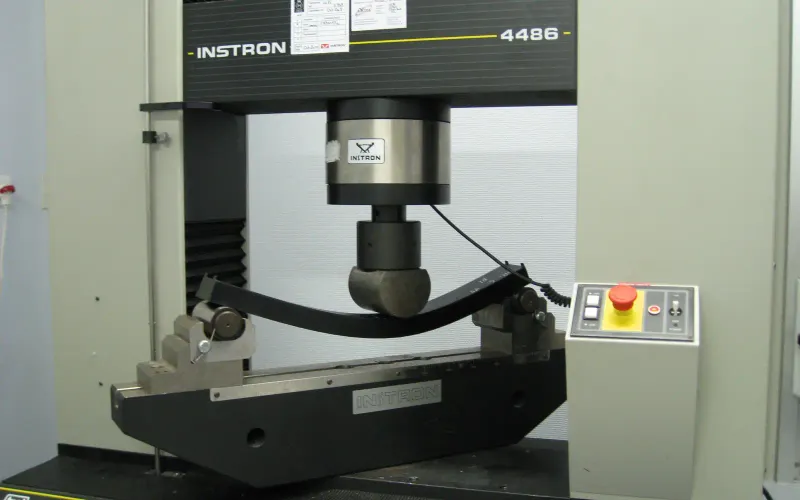
Rushil classifies its laminates to EN 438 and publishes the EN 438-2 results on each data sheet. TOPAZ, the compact worktop, reports 450 revolutions in the wear test against 150 required, and grade 5, the top of the scale, for boiling water, water vapour, dry heat at 160 °C and scratching. For fire, the VAULT data sheet reports a reaction-to-fire classification of B-s1,d0.
What is in the material is documented too. The TOPAZ data sheet reports a screening against all 253 substances on the REACH Candidate List, each at or below 0.1 % by weight, and the VAULT data sheet reports formaldehyde emission of 0.010 mg/m³ to EN 16516, against the EU limit of 0.062 mg/m³ that has applied to furniture and wood-based articles since August 2026. These are test results, not a declaration of conformity.
Where does the wood come from?
Rushil holds FSC and PEFC chain-of-custody certificates, issued by SGS in September 2025, for certified laminates made at its factory in Kalol, Gujarat. Both schemes exclude Russian and Belarusian wood. In 2022 FSC required certificate holders to stop sourcing controlled material from the two countries by 8 April that year, and PEFC classed all timber from them as conflict timber that cannot be used in PEFC-certified products, a ruling it extended indefinitely in December 2022.
That assurance covers laminates sold with an FSC or PEFC claim, so ask for the claim on the invoice and check the certificate in the public FSC and PEFC databases. Rushil's management system has been registered since 2007 and is now certified to ISO 9001, ISO 14001 and ISO 45001 across its sites, the Kalol factory included.
What this means for buyers
A trade agreement changes duties, not standards. Every laminate placed on the EU market has to meet the same rules wherever it is made, and the questions Europe's industry raises are the right ones to ask of any supplier. Rushil answers them with published test results and certificates that can be checked online; data sheets, test reports and copies of the certificates are available on request.
Common questions
Is the EU–India trade agreement in force?
Not yet. Negotiations concluded on 27 January 2026 and the Commission sent its proposals for signing and concluding the agreement to the Council on 11 September 2026. It then needs the consent of the European Parliament and India's ratification.
Do laminates from India have to meet the same EU rules?
Yes. Rules for products placed on the EU market apply whatever the country of origin; a trade agreement changes duties, not standards. Ask any supplier for EN 438 test results, fire classification, chemical screening and emission data.
Can FSC or PEFC certified laminate contain Russian or Belarusian wood?
No. Since 2022 FSC has excluded controlled material from Russia and Belarus, and PEFC treats all timber from both countries as conflict timber that cannot be used in certified products. The assurance applies to laminate sold with an FSC or PEFC claim.
Sources
- European Commission, DG Trade — EU trade relations with Indiaen
- European Commission, press release IP/26/1842 — Commission presents landmark India trade deal to Council for signatureSep 11, 2026 · en
- European Panel Federation (EPF) and ICDLI — Joint EPF and ICDLI Position Paper on the EU-India Free Trade AgreementSeptember 2026 · en
- ICDLI — International Committee of the Decorative Laminates Industry — European HPL Summit 2026: new data presentedOct 13, 2026 · en
- FSC — FSC requirements updated to enforce decision to reject FSC material from Russia, Belarus and conflict areas in UkraineMar 10, 2022 · en
- PEFC — Russia and Belarus conflict timber clarification extended indefinitelyDec 12, 2022 · en
- Rushil Decor — VIR VAULT (CGS / CGF) — Product Data Sheeten
- Rushil Decor — VIR TOPAZ (CGS / CGF) — Product Data Sheeten
Compiled for this site from the publications listed above. Summaries are in our own words, not quotations — read the originals for the full argument.