In short
- VAULT compact is made for washrooms: it gains 0.2 % mass in the EN 438 moisture test and 0.4 % in boiling water, against a permitted 2 % in each case.
- Its surface reduces bacteria and viruses by more than 99.99 % (JIS Z 2801, ISO 21702), and it meets the large-ball impact requirement of a drop height above 1800 mm.
- Choose the hardware first, then the thickness (VAULT: 10, 12, 13, 15 and 18 mm). If the fire strategy asks for a class, specify the CGF grade, classified B-s1, d0.
Why wet areas moved to compact
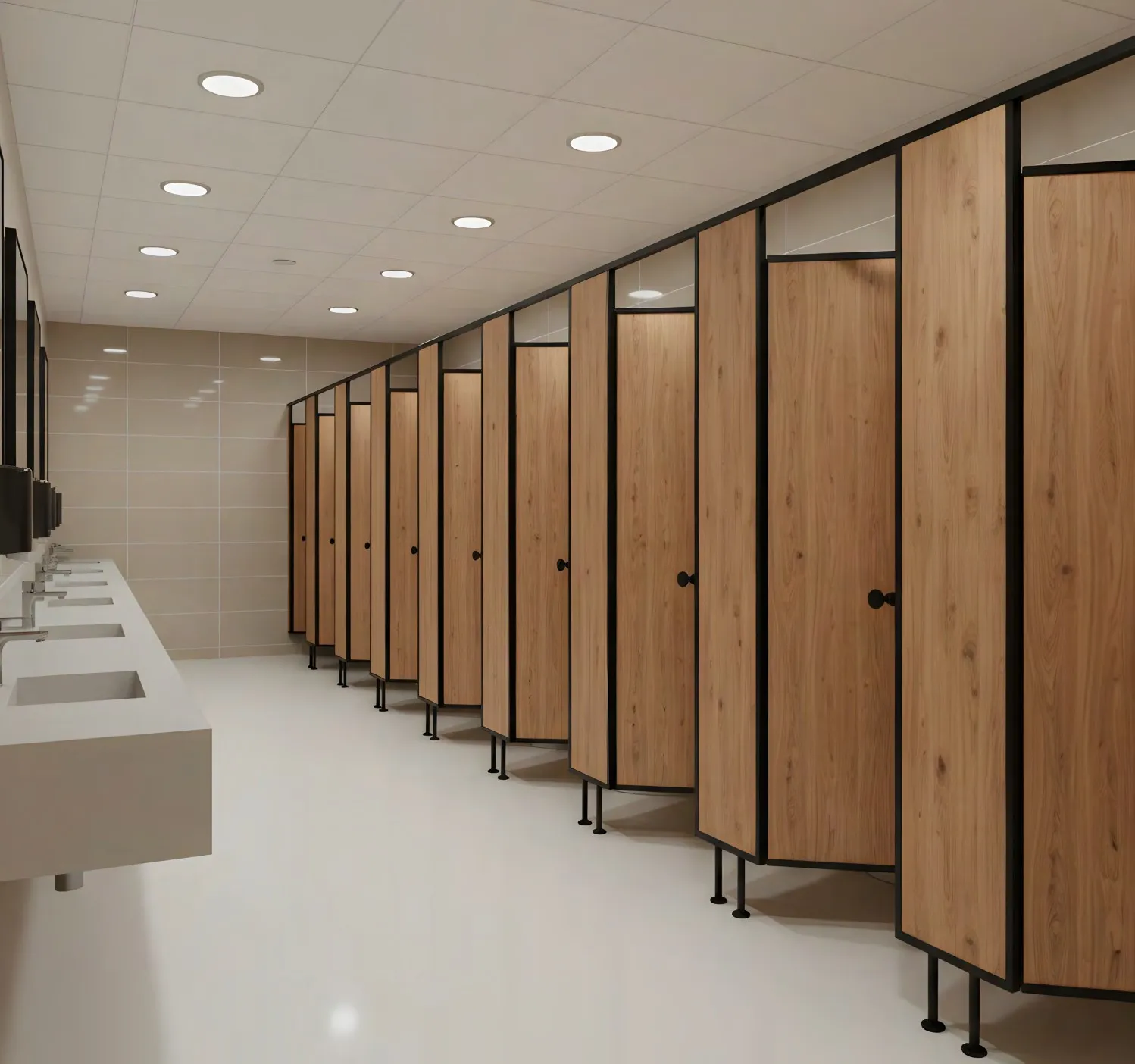
A cubicle panel is cut, drilled and edged on every side, and every one of those edges is exposed to water. A laminate bonded to a wood-based board fails at exactly those points. Compact laminate has no board inside it: the edge is the same material as the face, so there is nothing for water to reach.
The figures bear this out. VAULT records a mass increase of 0.2 % after moisture exposure to EN 438-2.15, and 0.4 % mass and 0.2 % thickness increase after immersion in boiling water to EN 438-2.12 — against a permitted 2 % in each case.
Grade first: standard or fire-retardant
VAULT is classified under EN 438-4 in two grades: CGS, the standard grade, and CGF, the fire-retardant one. They look identical and cost differently, and they are not interchangeable on a drawing.
If the building's fire strategy asks for a reaction-to-fire class on partitions and linings — common in schools, hospitals and transport buildings — it is the CGF grade that carries it: Rushil's documentation classifies CGF as B-s1, d0 to EN 13501-1. Confirm which thicknesses the fire report covers before you fix the thickness, because a classification belongs to a grade at a tested thickness, not to a product name.
Thickness follows the hardware
VAULT is documented at 10, 12, 13, 15 and 18 mm. In practice the hardware decides between them: hinges, brackets, feet and locks are made for a specific panel thickness, and a panel that does not match the system has to be machined to fit or replaced.
Choose the hardware system, then the thickness, then the format. VAULT is made in 1830 × 1830, 1830 × 2165, 1830 × 3660 and 1830 × 4330 mm. Nest the door, partition and pilaster sizes into those sheets before committing — on a run of identical cubicles the offcut decides more of the cost than the price per square metre.
Hygiene: what the surface tests show
The panel surface is tested three ways. Antibacterial activity to JIS Z 2801 is above 99.99 %, where the method requires at least 99 %. Antiviral activity to ISO 21702 is also above 99.99 %. Antifungal resistance to ASTM G21 is rated 0 — no growth — where 1 would be accepted.
These are laboratory results on the panel surface, and they describe a surface that does not support growth between cleans. They do not replace cleaning, and the cleaning itself matters as much: the surface resists the staining groups of EN 438-2.26 at the top grade, which is what makes routine disinfection possible without marking it.
Impact, scratching and fixings
Cubicle doors are slammed and partitions are leaned on. VAULT meets the EN 438-4 large-ball impact requirement of a drop height above 1800 mm, and scratch resistance to EN 438-2.25 is grade 5, the top of the scale.
For fixings, screw pullout to ISO 13894-1 is 3 514 N. Use it to check the hardware supplier's fixing schedule, especially for pilasters and wall brackets that carry a door's weight on a few screws.
Lockers
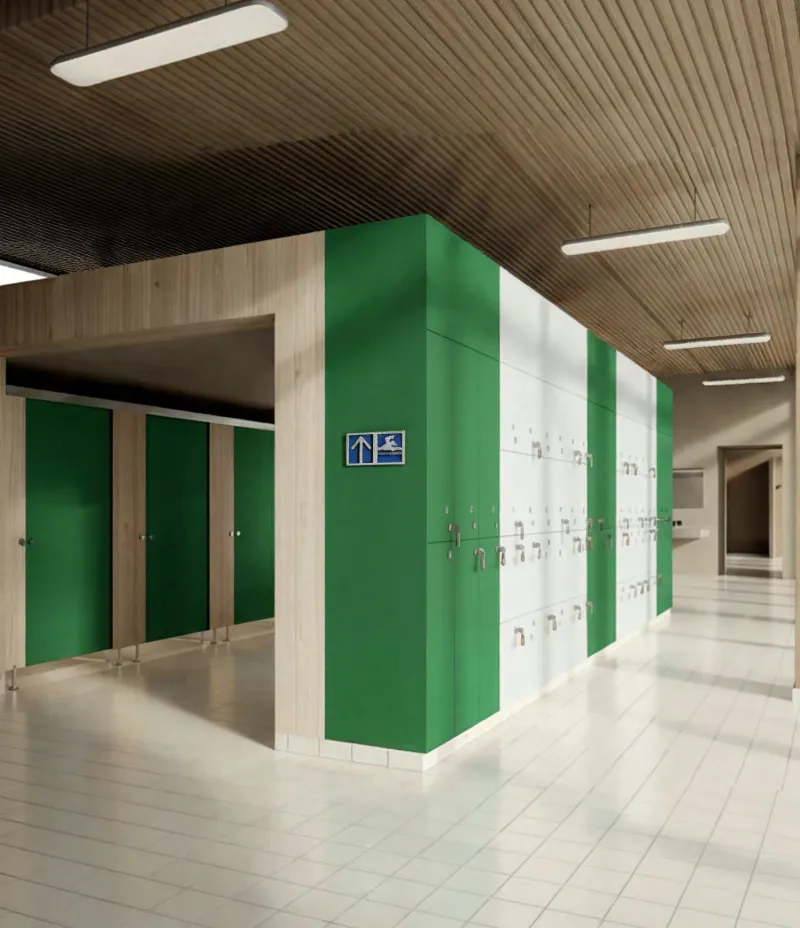
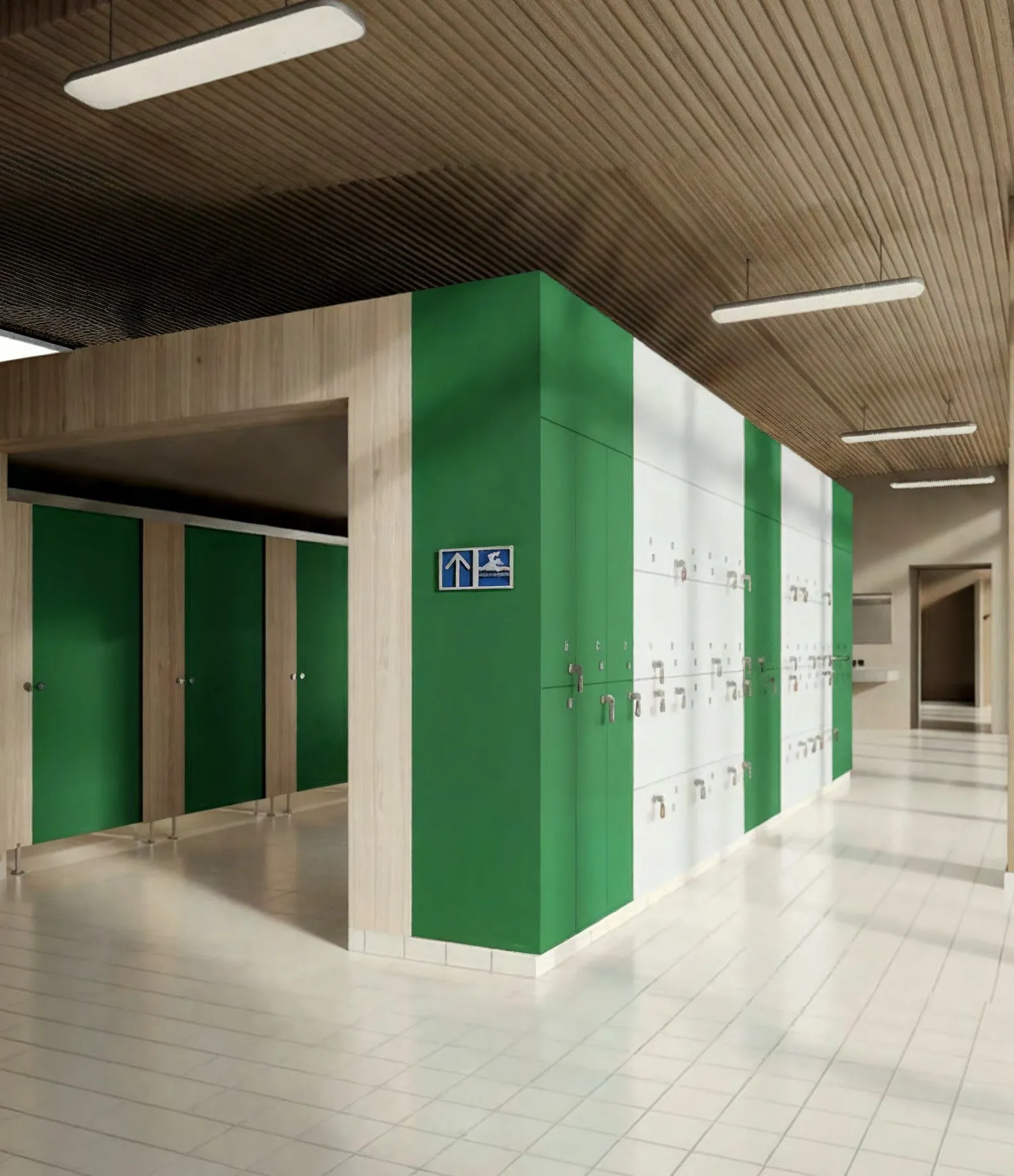
The VAULT catalogue includes a modular locker range from one to six tiers, named Alpha to Zeta. Every model is 300 mm wide, 435 mm deep inside and 465 mm outside, and 1830 mm high; the door height per tier runs from 1830 mm for a single door down to 300 mm for six tiers. They are delivered flat-packed.
The catalogue presents cubicles and lockers as complete systems made with Kich Hardware. Whether a project in your market is supplied as panels only or as a complete system with hardware is something to confirm in the quotation, not to assume from the catalogue.
Common questions
What thickness should compact cubicle panels be?
VAULT is documented at 10, 12, 13, 15 and 18 mm. The hardware system usually fixes the thickness, because hinges, brackets and feet are made for one panel thickness — choose the system first, then confirm the panel thickness against it.
Do toilet cubicles need a fire-retardant grade?
Only if the building's fire strategy or local regulation requires a reaction-to-fire class for partitions. If it does, specify CGF, the fire-retardant grade, and confirm the tested thickness in the fire report. Rushil's documentation ties the B-s1, d0 classification to CGF, not to the standard grade.
Are VAULT lockers supplied assembled?
The catalogue describes them as delivered in flat packs for installation on site. Confirm the supply scope — panels, hardware, assembly — in the quotation for your project.
Written for this site from manufacturer test reports. Not reproduced from any other source.