In short
- For door faces and wall panelling on a board, specify decorative HPL to EN 438-3; for free-standing partitions, lockers and exposed lower walls, self-supporting compact to EN 438-4. Horizontal HGS is worth asking for at trolley height, even on a vertical surface.
- EN 438's large-ball test drops a 324 g steel ball from rising heights. Rushil's Decorative HPL and its VAULT compact both exceed a drop height of 1800 mm — about 5.7 J — where the Decorative HPL data sheet requires 800 mm.
- A panel test is not a wall test: guidance for hospitals still expects crash rails, corner guards and protective sheeting where beds and trolleys strike. Compact resists surface damage, but it is not an anti-vandal material.
How this guide was put together
This guide draws on Technical Leaflet 24 of the German laminate industry group, which explains what each test in EN 438-2 is for; on Part B of Health Building Note 00-10, England's guidance on walls and ceilings in healthcare buildings; on BibLus's guide to designing healthcare facilities; on the Deutsche BauZeitschrift's survey of school doors; on the UK housing ministry's note on testing fire doors as complete sets; and on Rushil's data sheets. The leaflet describes the draft of the test standard from 2000, so check the current edition for procedure. We found no European impact class written specifically for airport walls, so that part of the guide reasons from the same evidence.
Which HPL goes where
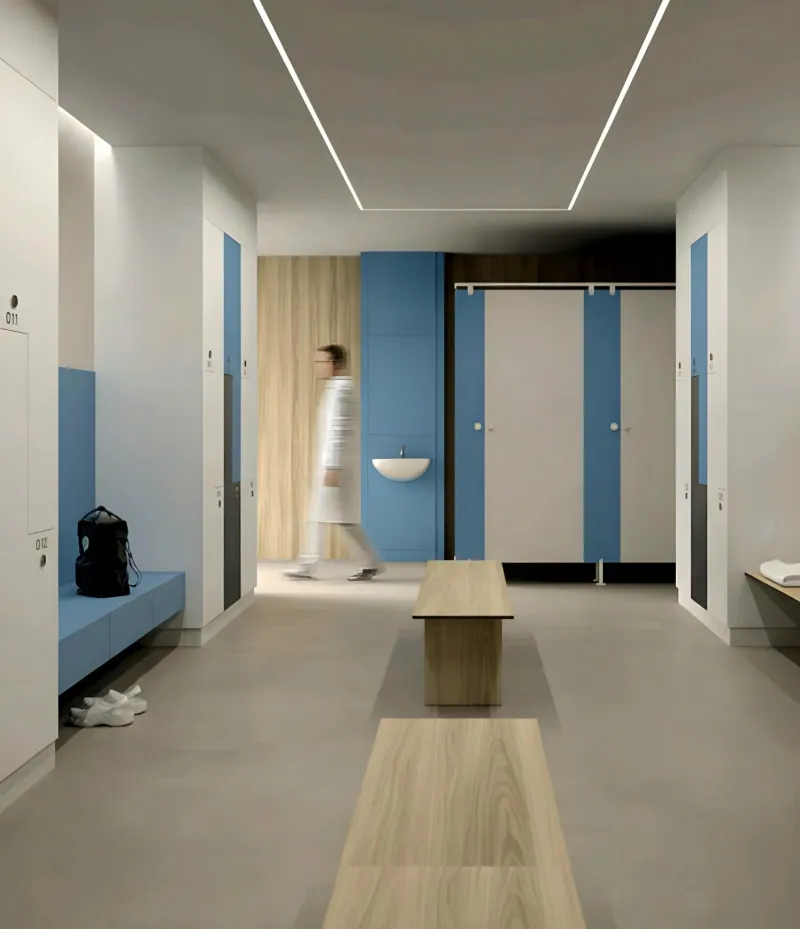
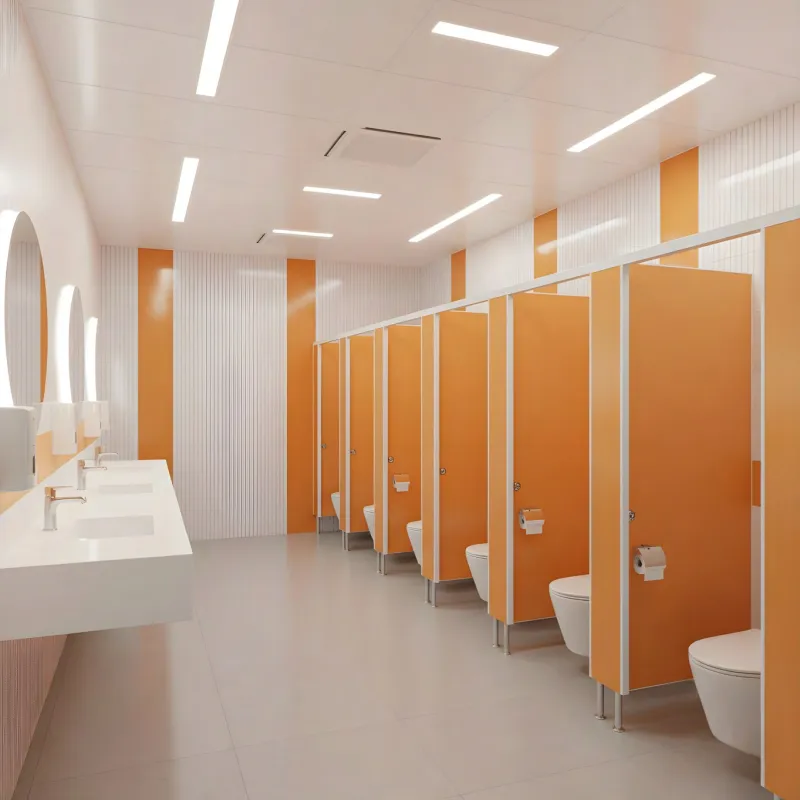
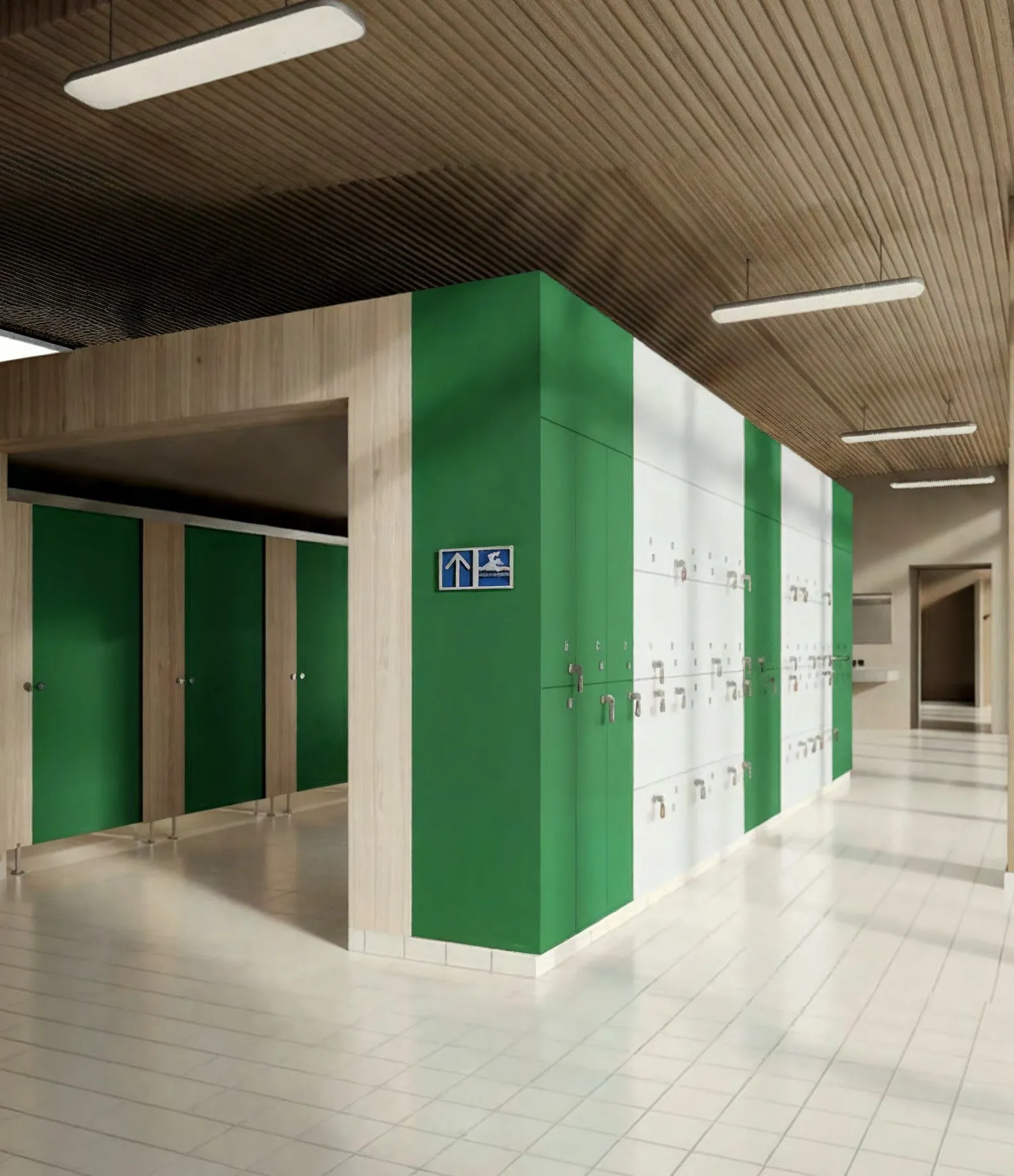
Two families of panel do the work, and the part of EN 438 on the data sheet tells them apart. Decorative HPL under EN 438-3 is a thin sheet, up to 1.8 mm in Rushil's range, bonded to a board: it suits door faces, wall panelling and furniture fronts. Compact under EN 438-4 is self-supporting and needs no board: it suits partitions, cubicles, lockers and wall linings that are exposed at their edges or in wet areas.
Within decorative HPL, Rushil supplies horizontal and vertical general-purpose grades, HGS and VGS. V grades are meant for surfaces subject to less wear, so on a door or a wall at trolley height it is worth asking for HGS even though the surface is vertical. Within compact, CGS is the standard grade and CGF the fire-retardant one, classified B-s1,d0; where the fire strategy sets a class for linings or partitions, as is common in schools, hospitals and transport buildings, CGF is the grade that carries it.
What the two ball tests measure
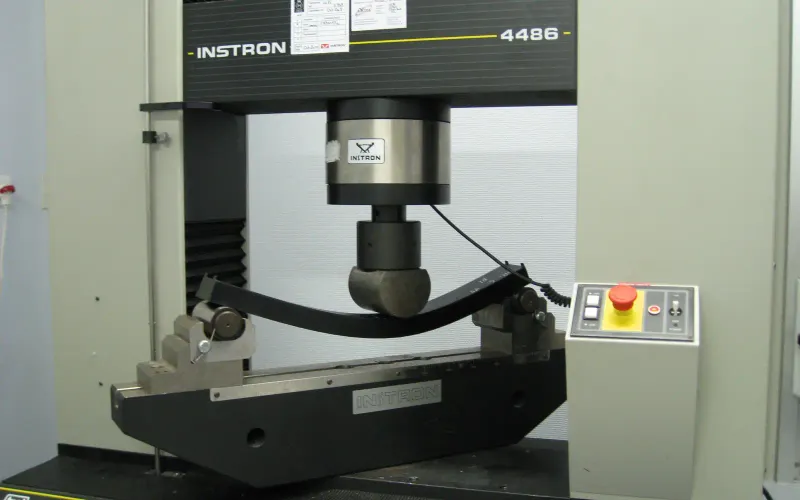
EN 438-2 has two impact tests. The small-ball test, section 20, strikes the surface of an HPL element, a laminate bonded to chipboard, with a 5 mm steel ball at rising force until damage shows; the result is the highest force that causes no damage in five tries. It applies only to laminates under 2 mm that are meant to be bonded.
The large-ball test, section 21, drops a 324 g steel ball, 42.8 mm across, from rising heights onto the surface until damage shows. The result is the greatest drop height with no surface damage in five consecutive impacts, and the test covers both bonded laminates and compact panels. By our arithmetic a 324 g ball falling 1.8 m arrives with about 5.7 joules, about as much as a 1 kg tool dropped from 58 cm.
Both tests imitate a hard object falling on a surface. Neither imitates a bed frame sliding along a corridor wall, and for a bonded laminate the result also depends on the board behind it.
Reading the results on a data sheet
Rushil's Decorative HPL data sheet reports more than 33 N in the small-ball test against a required 20 N, and a drop height above 1800 mm in the large-ball test against a required 800 mm, at an indentation diameter of 9 mm. Those are the headline numbers for a door face, and the margin in the large-ball test is more than double.
The TOPAZ and VAULT data sheets report a drop height above 1800 mm for compact of 6 mm and more, at an indentation diameter of 10 mm. Rushil's 6 mm exterior compact, KLADS, took 1800 mm with a dent of 5 mm, against a required 1400 mm. Scratching is a separate test, and VAULT is grade 5 there, the top of the scale. Always read the drop height together with the indentation and the thickness: a figure without them cannot be compared.
Hospitals: panels and rails work together
Part B of HBN 00-10 asks for wall finishes durable enough to withstand minor impacts without additional wall protection. Where protection is needed, the fittings it lists include protective plates and sheeting alongside handrails, crash rails and corner guards. BibLus's guide adds rubber, PVC or aluminium bumpers at the height where beds, trolleys and stretchers strike the wall, and walls washable to at least 2.0 m in working rooms.
Compact fits that picture as the sheeting: a hard, non-porous, cleanable surface down to floor level, with the rail still taking the blows from bed frames. VAULT adds grade 5 in all three EN 438 staining groups and a bacterial reduction above 99.99 % to JIS Z 2801.
Schools: doors take the worst of it
The Deutsche BauZeitschrift's survey notes that, because of heavy use, school doors should ideally meet stress class 4 under DIN EN 1192, a test of the door as a whole. It names robust HPL laminate for wet-room doors, ideally with a cast-on PU or ABS edge, and lists HPL alongside veneer and premium lacquer for classroom doors.
The panel gives the face its resistance; the door's edge, core and hardware decide the rest. That is why the edge detail deserves as much attention as the laminate, and why a fire door is judged as a complete tested doorset, not by the class of its surface.
Airports, stations and other busy public buildings
We found no impact class written for terminal walls, so the logic is the same as in a hospital corridor, with luggage trolleys in place of beds. Put compact at low level where wheels and cases strike, fix it mechanically so a damaged panel can be replaced on its own, and protect outside corners. Check the class the fire rules require on escape routes, and the thickness and mounting that the classification report covers.
Contrast helps too: a difference of at least 30 LRV points between a wall and a door or a handrail is what much accessibility guidance works with. Compact is resistant to surface damage, but it is not an anti-vandal material, and it should not be specified as one.
What to put in the specification
A short list keeps a tender comparable.
- Panel family and standard: decorative HPL to EN 438-3 on a named board, or compact to EN 438-4.
- Large-ball result: drop height, indentation and thickness, together.
- Grade: HGS for a door or wall at trolley height; CGF where a fire class is required.
- Edges: a protected or cast-on edge for bonded doors; compact where edges are exposed.
- Protection: rails, corner guards and fixings that let a panel be replaced.
Common questions
What HPL is used for wall cladding and door faces in schools and hospitals?
Door faces and wall panelling use decorative HPL to EN 438-3, bonded to a board, usually in a horizontal general-purpose grade where wear is high. Partitions, lockers and exposed or wet wall linings use self-supporting compact to EN 438-4, in the fire-retardant CGF grade where a fire class is required.
What does a drop height of 1800 mm mean?
In the EN 438-2 large-ball test, a 324 g steel ball fell from 1.8 m in five consecutive impacts without damaging the surface, which is about 5.7 joules by our arithmetic. Read it with the stated indentation and thickness.
Does a compact wall still need crash rails?
Where beds, trolleys or luggage carts strike regularly, yes. HBN 00-10 lists crash rails and corner guards alongside protective sheeting, and BibLus's guide puts bumpers at the height of the impact. A panel test describes a surface, not a wall under repeated blows.
Is compact HPL vandal-proof?
No. It is resistant to surface damage, with scratch grade 5 for VAULT, but it is not an anti-vandal material. Fix it so that a damaged panel can be replaced on its own.
Sources
- Fachgruppe Dekorative Schichtstoffplatten — Technisches Merkblatt 24: Überblick über die in prEN 438-2:2000 beschriebenen PrüfmethodenApril 2002 · de
- Department of Health, Health Building Note 00-10 — Part B: Walls and ceilingsen
- BibLus (ACCA software) — Progettazione strutture sanitarie, una guida con file di esempio da scaricareJul 9, 2018 · it
- Deutsche BauZeitschrift (DBZ) — Schultüren – viele Anforderungen, unzählige MöglichkeitenJune 2020 · de
- Ministry of Housing, Communities and Local Government — Removal of national classifications: final stage impact assessmenten
- Rushil Decor — Decorative HPL (HGS / VGS) — Product Data Sheeten
- Rushil Decor — VIR VAULT (CGS / CGF) — Product Data Sheeten
- Rushil Decor — VIR KLADS (EDS / EDF) — Product Data Sheeten
Compiled for this site from the publications listed above. Summaries are in our own words, not quotations — read the originals for the full argument.