In short
- European technical sources ask hospital and school walls to be washable, non-porous, impact- and scratch-resistant — and compact HPL's test data answer each point: VAULT reaches the top staining grades, grade 5 for scratching and a large-ball drop height above 1800 mm.
- For indoor air, ask for the VOC class, an EN 16516 certificate and an EPD: VAULT emits 0.010 mg/m³ of formaldehyde to EN 16516 against a limit of 0.124, and Rushil holds EN 15804 EPDs for thin and compact HPL, valid until 2031.
- Rushil's fire-retardant compact grades are classified B-s1, d0; for escape routes, confirm the thickness and mounting the report covers and the class the national rules require.
How this review was put together
This article draws on three technical articles from BibLus, the journal of the Italian software house ACCA — one on HPL in construction and two design guides for healthcare buildings — together with the Italian engineering magazine Ingenio on reaction to fire, the Italian building portal Infobuild on indoor air quality, and the Deutsche BauZeitschrift on school doors. Every point is attributed, and the sources are listed at the end.
Most of these sources are not about HPL. That is deliberate: they describe what a public interior demands of any surface, and the material is measured against the requirement rather than the other way round.
Where HPL appears inside public buildings
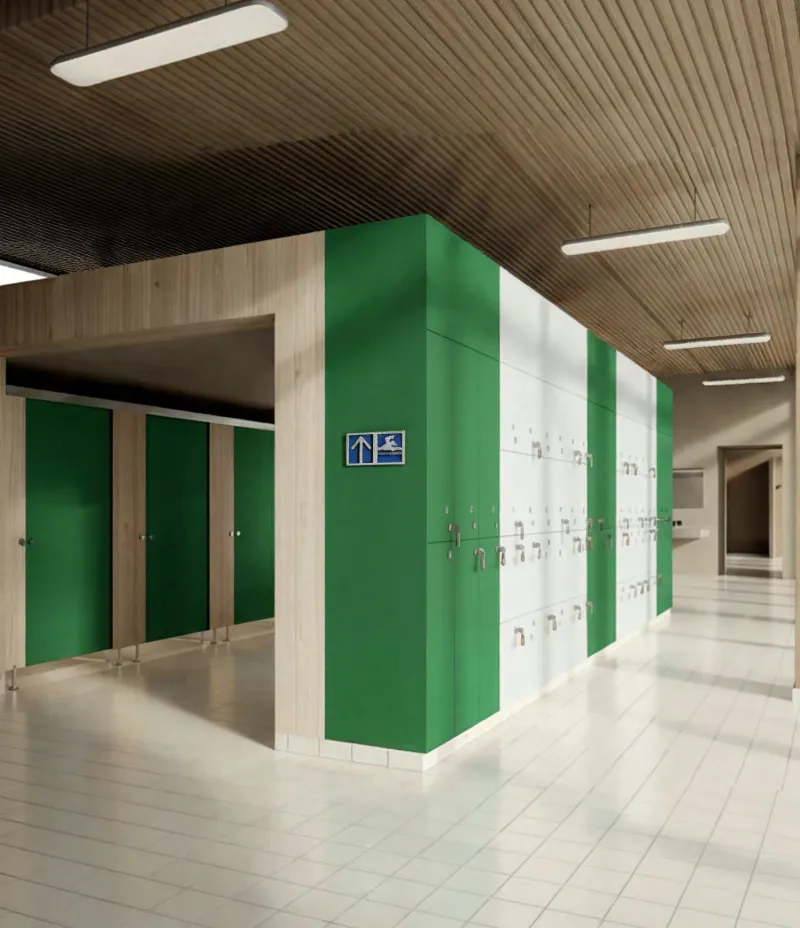
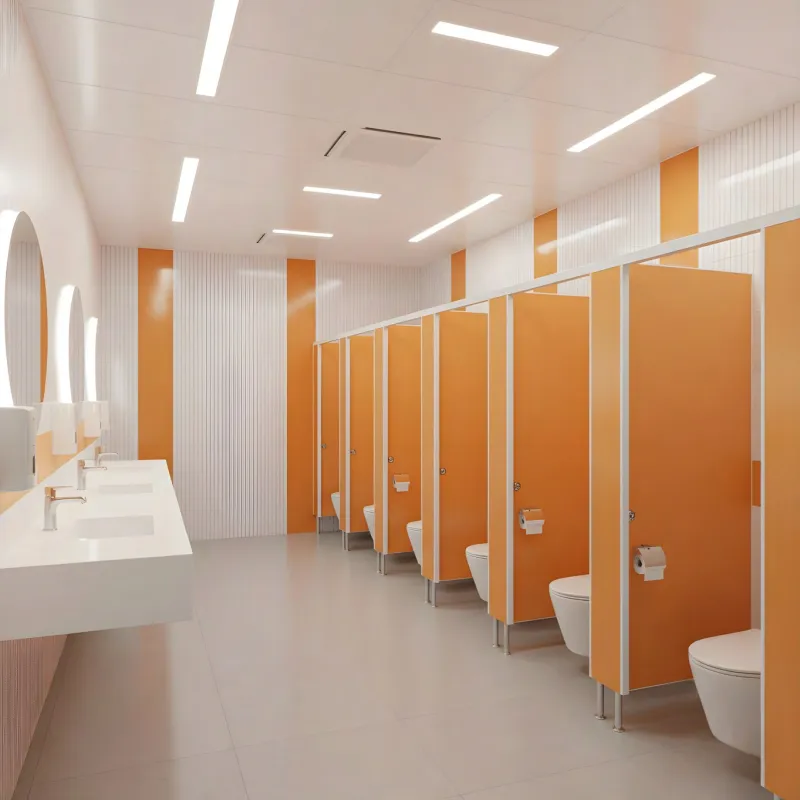
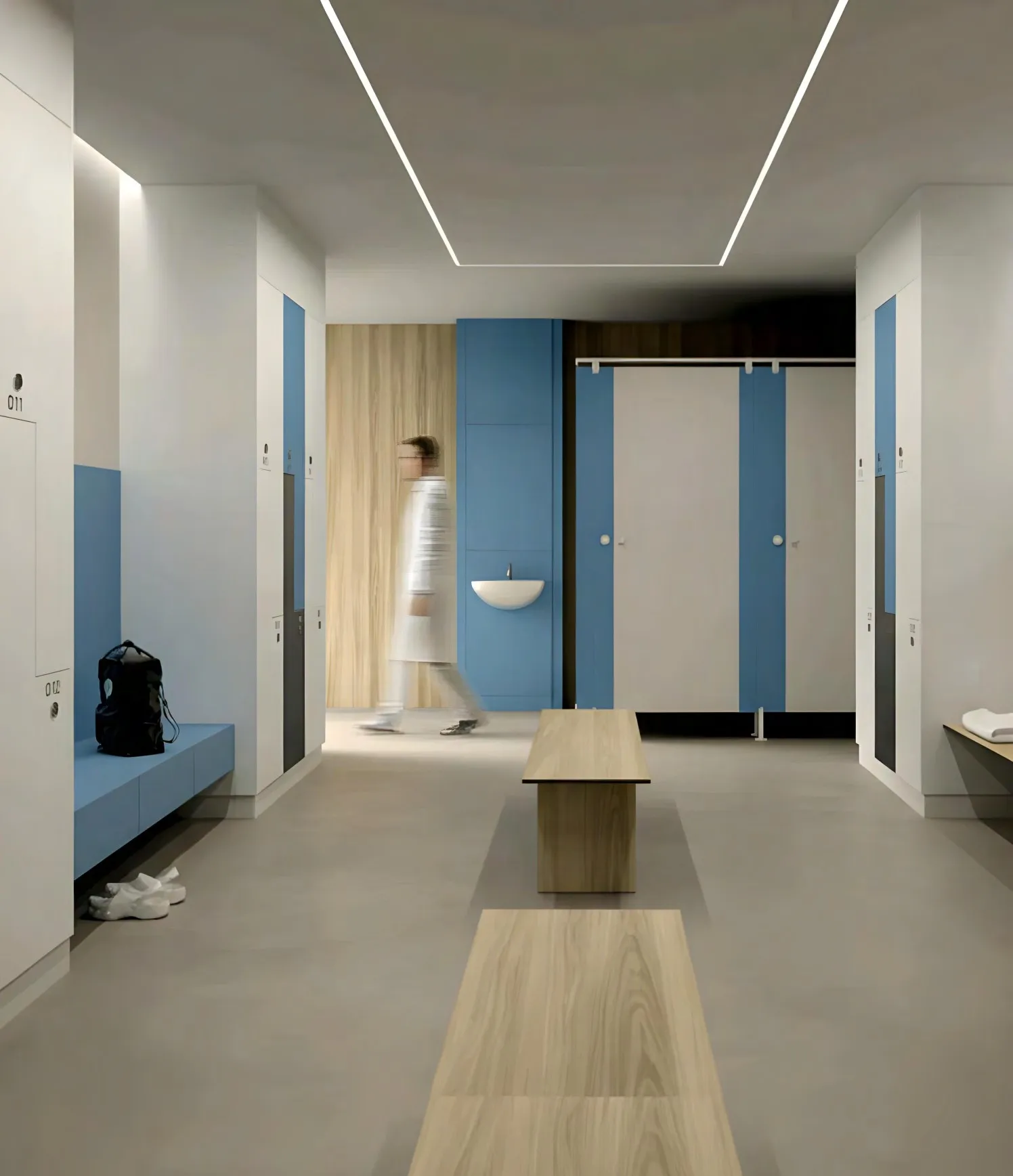
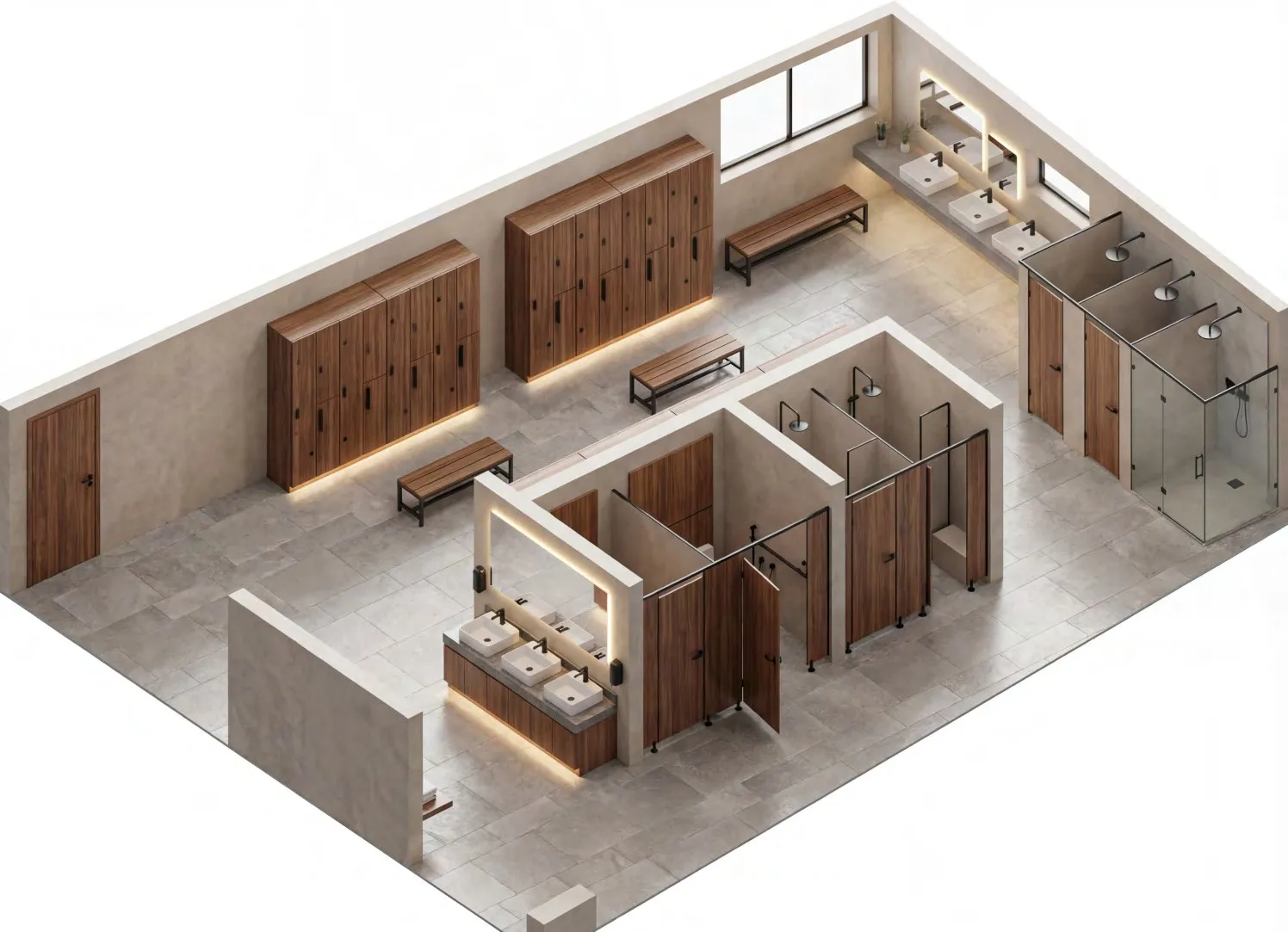
BibLus lists the interior uses: wall cladding and partitions in hospitals and clinics, laboratories and clean rooms, schools, airports, stations and other transport buildings, and high-traffic shopping and public spaces; washroom systems — partitions, cubicle doors, changing-room lockers and linings for wet areas such as pools and sports centres; and furniture and work surfaces — worktops, bar, reception and retail counters, contract tables, furniture fronts, interior doors and window frames.
The same article notes that panels with a coloured core avoid the dark edge of a standard phenolic core, and that EN 438-7 — the part covering compact and composite HPL panels for wall and ceiling finishes — is the one that links the product to CE marking.
Hospitals: what the design guides ask of a wall
BibLus's 2018 guide to designing healthcare facilities sets out the requirements for interior walls. Linings must meet hygiene, appearance and fit-out needs; joints between partition panels must be perfectly sealed; surfaces must be easy to clean, impact-resistant, resistant to disinfection chemicals, scratch-resistant and non-porous; and walls must give adequate sound insulation between rooms. In rooms with heavy medical equipment, walls should house services so they can be inspected and maintained.
The guide adds that in working rooms floors and walls should be non-absorbent and washable to a height of at least 2.0 m; that rubber, PVC or aluminium bumpers belong at the height where beds, trolleys and stretchers strike the wall; and that skirtings must withstand both floor-cleaning machines and cleaning products. Its companion guide to healthcare buildings asks for entrance and circulation finishes that are non-absorbent and free of discontinuities, with a rounded junction between wall and floor and materials that resist disinfectants.
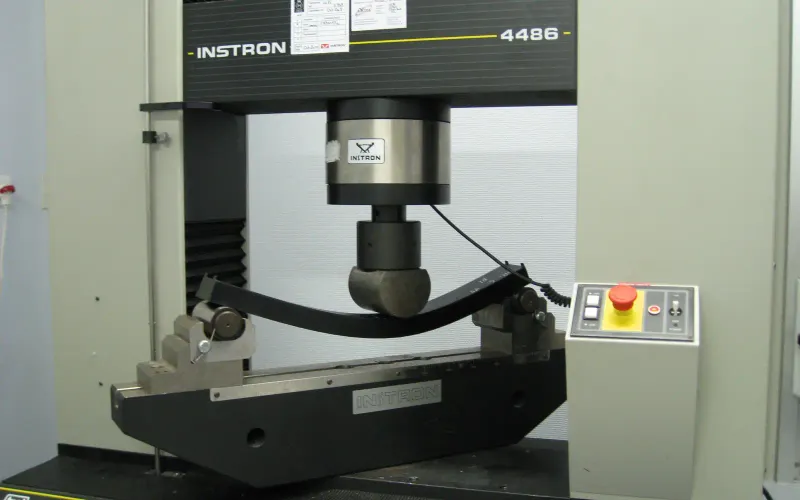
Read against compact laminate data, most of that list is a surface question the test results already answer: the surface is non-porous, VAULT reaches the top grade in the EN 438-2.26 staining groups and grade 5 for scratching, and it meets the large-ball impact requirement at a drop height above 1800 mm. What the panel cannot provide on its own is the sealed joint and the continuous surface — those are detailing decisions, made at the joints between panels and at the junction with the floor.
Schools: doors and wet rooms
The Deutsche BauZeitschrift's 2020 survey of school doors notes that, because of heavy use, school doors should ideally meet stress class 4 under DIN EN 1192, and that wet rooms need moisture-tolerant materials, corrosion-resistant fittings that are easy to clean and resistance to cleaning agents. It names robust HPL laminate for wet-room doors, ideally with a cast-on PU or ABS edge, and lists HPL alongside wood veneer and premium lacquer for classroom doors.
Its example is the Gesamtschule Lippstadt by Swiatkowski-Suerkemper Architekten, which used about ten door types: T30 timber doors in birch or beech veneer with glazed sidelights rated Rw,P 37 dB for most classrooms, T30 fire doors in the science rooms, wet- and damp-room doors with robust HPL laminate in the washrooms, and damp-room doors with fire, smoke and sound protection, matched to the colour concept, in the busy corridors.
Fire: linings are judged as installed
Ingenio's 2019 analysis of the Italian fire code explains that reaction to fire is a passive measure that mainly limits ignition and early fire growth, and that the code sets the required level by the risk to life in each area — with escape routes treated more strictly than other rooms. Its central point is that a classification describes a product of a given thickness, density and composition in its actual installed condition: fixed vertically or horizontally, with or without an air gap behind it. Change the installation and the result may change.
BibLus adds that the manufacturer must declare the EN 13501-1 class. Rushil's documentation classifies its fire-retardant compact grades as B-s1, d0; before specifying them for an escape route, confirm the thickness and the mounting the classification report covers, and check the class the national rules require there.
Indoor air: what to ask for
Infobuild's June 2026 article on interior finishes notes that Italy's minimum environmental criteria for public works (CAM), updated by a decree of 24 November 2025 and in force since 2 February 2026, set emission limits for materials in public contracts, and that the higher indoor-air quality level is recommended for spaces used by vulnerable people such as children and the elderly. It recommends always asking for the VOC emission class on the A+ to C scale, a test certificate to EN 16516, confirmation that the product contains no substances of very high concern, and, where available, an Environmental Product Declaration to EN 15804 — and warns that primers, adhesives and fillers can add emissions of their own, so the whole system should be assessed, not only the visible finish.
Rushil's documentation answers most of that list. The VAULT data sheet reports formaldehyde emission of 0.010 mg/m³ to EN 16516 against a limit of 0.124, with a full CDPH VOC panel; the TOPAZ data sheet reports a screen against the 253 substances on the REACH candidate list; and Rushil's 2026 sustainability summary lists registered EPDs to EN 15804 for both thin and compact HPL, valid until 2031, which are supplied on request.
Colour, edge and finding the way
BibLus's healthcare building guide asks for a reception that is easy to identify, and suggests lighting, colour, materials or distinctive forms to achieve it — a decision about surfaces as much as layout. Our guide to light reflectance value covers the related question of contrast between doors, walls and floors for people with low vision.
Edges matter in the same way. Rushil's interior compact grades have a black phenolic core, so every exposed edge shows a dark line; a core coloured to match the face, which BibLus describes as an option on the market, is not documented for the Rushil range on this site. Where the edge should disappear, it has to be designed out — with profiles, rebates or a decorative laminate bonded to a substrate.
Reading this against the Rushil range
VAULT is Rushil's interior compact system for washrooms, changing rooms and partitions, classified to EN 438-4 in a standard grade and a fire-retardant grade, with the hygiene, impact and emission data cited above. The compact programme covers counters and work surfaces, and decorative HPL to EN 438-3 is the choice for wall panelling, furniture fronts and doors bonded to a substrate.
For the details that sit behind this article, our guides to toilet cubicles and lockers, to light reflectance value and to hygiene and food-contact test results go further, each from the test data.
Common questions
Is HPL suitable for hospital walls?
BibLus's healthcare design guide asks for wall surfaces that are easy to clean, impact-resistant, resistant to disinfection chemicals, scratch-resistant and non-porous, with perfectly sealed joints. Compact HPL's test data answer the surface requirements; sealed joints and continuous junctions are detailing. Check the hospital's disinfection products against the staining results before specifying.
Can HPL be used to line escape routes?
That depends on the national rules for the building and on the class they require in escape routes, which are treated more strictly than other rooms. Ingenio stresses that a classification is valid only for the tested installation. Rushil's fire-retardant grades are classified B-s1, d0; confirm the thickness and mounting the report covers.
Which documents should a public tender ask for?
BibLus points to CE marking with a Declaration of Performance for wall and ceiling finishes and the declared EN 13501-1 class; Infobuild adds the VOC emission class, an EN 16516 test certificate, confirmation of no substances of very high concern and an EPD to EN 15804. Rushil's data sheets and EPDs cover most of these; ask for the full set with the quotation.
Sources
- BibLus (ACCA software) — Applicazioni del laminato HPL nel settore edileFeb 26, 2026 · it
- BibLus (ACCA software) — Progettazione strutture sanitarie, una guida con file di esempio da scaricareJul 9, 2018 · it
- BibLus (ACCA software) — Edilizia sanitaria, criteri di progettazione, norme ed esempi dwg da scaricareJul 2, 2018 · it
- Ingenio, Giuseppe Gaspare Amaro, D. Amato — Come individuare la reazione al fuoco dei materiali: attenzione alle modalità di installazioneApr 17, 2019 · it
- Infobuild, Raffaella Capritti — Finiture interne: pitture, materiali e salubrità degli ambientiJun 8, 2026 · it
- Deutsche BauZeitschrift (DBZ) — Schultüren – viele Anforderungen, unzählige MöglichkeitenJune 2020 · de
Compiled for this site from the publications listed above. Summaries are in our own words, not quotations — read the originals for the full argument.