In short
- The European laminate industry expects HPL to last at least 20 years indoors without loss of appearance and performance, and 20 to 50 years in standard applications.
- Service life now counts for carbon: in the 50-year whole-life calculation new buildings must report, a surface replaced every 20 years counts three times, one that lasts the whole period once.
- Rushil's TOPAZ shows the durability behind it: 450 wear revolutions against 150 required, grade 5 for scratching, dry heat, steam and stains, and light fastness of 5 on the grey scale.
How this guide was put together
This guide draws on two technical leaflets and a 2026 white paper from the ICDLI, the European laminate industry's association; on the industry-average Environmental Product Declaration for HPL that the ICDLI registered with the German programme operator IBU in 2022; on the EU's recast Energy Performance of Buildings Directive; and on Rushil's data sheets for TOPAZ and KLADS.
What the industry says
Compared with paints, thermoplastic foils and veneers, the ICDLI writes, HPL offers a significantly longer life, and for indoor applications a minimum life of 20 years can be expected without loss of appearance and performance. Its 2026 white paper puts it more broadly: depending on the application and conditions of use, HPL will last at least 20 to 50 years, and longer use reduces the need for frequent replacement.
The industry EPD is careful about the same point. Because HPL is used in so many ways, it says, no single reference service life can be set; for information, service life in standard applications can range from 20 to 50 years, an estimate the ICDLI bases on expert judgement. It is an estimate, not a guarantee: how long a surface lasts depends on what it is asked to do.
Why the number now counts for carbon
Under the recast Energy Performance of Buildings Directive, the life-cycle global warming potential of new buildings has to be calculated and disclosed, from 2028 for buildings over 1000 m² and from 2030 for all, over a reference study period of 50 years, to EN 15978. In such a calculation replacements count. A surface that lasts the whole period enters the sum once; one replaced every 20 years enters it three times; one replaced every ten years, five times.
Service life therefore multiplies the embodied impact of a finish directly. A surface that stays in place for decades is not only cheaper to own; it is lighter on the building's carbon account.
What lets HPL last
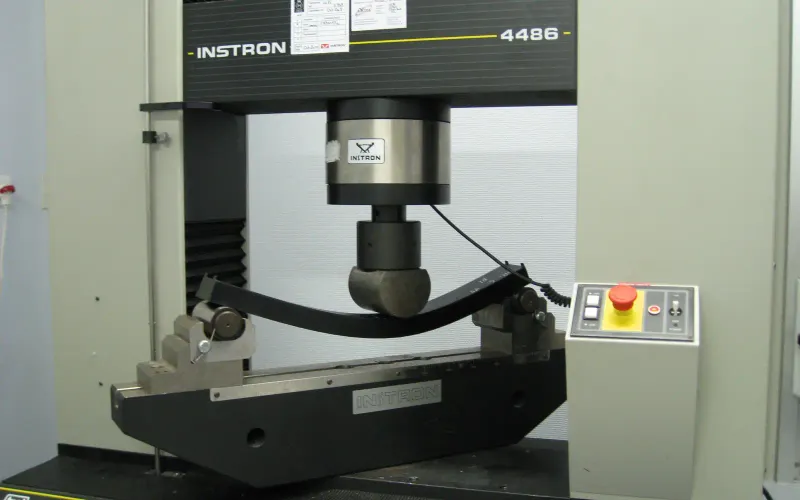
The surface of HPL is cured melamine resin, a thermoset that does not melt again, over a core of resin-bonded paper. The EN 438 tests reproduce what a surface meets in use: abrasion, scratching, heat, steam, water, stains and light. Rushil's TOPAZ data sheet reports 450 revolutions to the initial point of wear against 150 required; grade 5, the top of the scale, for scratching, dry heat at 160 °C, water vapour and all three staining groups; a 0.4 % mass gain in boiling water against a limit of 2 %; and light fastness of 5 on the grey scale and 6 on the blue wool scale.
Outdoors, the KLADS data sheet reports grade 5 for appearance and 4 to 5 for colour after 3,000 hours of artificial weathering. These are test results, not a declaration of conformity, but they describe a surface built for the long run.
Looking after it
Long life does not depend on special care. HPL surfaces need no special treatment or maintenance, the ICDLI notes, and its 2026 white paper adds that chemical cleaning agents are not necessary; Rushil's guide to cleaning covers the stubborn cases.
What this means for a project
The industry's own estimate puts HPL at 20 to 50 years, and for interiors at no less than 20 without loss of appearance. In a 50-year carbon calculation, every replacement avoided is a product not made, shipped and fitted again. Rushil's data sheets show the surface strength behind that; Environmental Product Declarations for thin and compact HPL, data sheets and samples are available on request.
Common questions
How long does HPL last?
The ICDLI expects at least 20 years indoors without loss of appearance and performance, and its industry EPD gives 20 to 50 years in standard applications as an expert estimate. Actual service life depends on the use.
Why does service life matter for whole-life carbon?
EU rules require new buildings to report life-cycle global warming potential over 50 years from 2028 or 2030. Replacements count in that calculation: a surface replaced every 20 years is counted three times, one that lasts the whole period only once.
What do Rushil's tests show about durability?
The TOPAZ data sheet reports 450 revolutions to the initial point of wear against 150 required, grade 5 for scratching, dry heat, water vapour and staining, and light fastness of 5 on the grey scale. These are test results, not a declaration of conformity.
Sources
- ICDLI — International Committee of the Decorative Laminates Industry — Characteristics and Possibilities of Use for Decorative High Pressure Laminates (HPL) (technical leaflet)December 2017 · en
- ICDLI — International Committee of the Decorative Laminates Industry — European HPL: Engineered for Excellence (white paper)July 2026 · en
- Institut Bauen und Umwelt (IBU), declaration owner ICDLI — Environmental Product Declaration EPD-ICL-20220238-CBE1-EN: HPL (Decorative High-Pressure Laminates)Nov 18, 2022 · en
- ICDLI — International Committee of the Decorative Laminates Industry — An Introduction to Manufacturing and Material Types (technical leaflet)July 2015 · en
- Official Journal of the European Union L series — Directive (EU) 2024/1275 on the energy performance of buildings (recast)May 8, 2024 · en
- Rushil Decor — VIR TOPAZ (CGS / CGF) — Product Data Sheeten
- Rushil Decor — VIR KLADS (EDS / EDF) — Product Data Sheeten
Compiled for this site from the publications listed above. Summaries are in our own words, not quotations — read the originals for the full argument.