In short
- The makers of modern design classics put HPL on their short list: Artek offers Alvar Aalto's tables in high-pressure laminate, and Vitra makes Jean Prouvé's EM Table with a 40 mm HPL top laminated on surface and edges.
- The Eames Tables had laminate tops from the start: the first contract-base tables, released in 1958, came with them, and Vitra still offers HPL tops today.
- HPL is not a melamine-faced board: it is pressed into a sheet first. Rushil makes decorative HPL from 0.5 to 1.8 mm, with more than 200 plain colours among its 445 decors.
How this review was put together
This article draws on the product pages of Artek, which makes Alvar Aalto's furniture in Finland, and of Vitra, which makes Jean Prouvé's furniture and is the authorised maker of Eames products for Europe and the Middle East. Each point is attributed, and the sources are listed at the end.
Three classics, one everyday top
Alvar Aalto's tables date from 1933, Jean Prouvé's EM Table from 1950 and the Eames Tables from 1964 and 1968. All three are still in production, and each maker offers only a few top materials. Beside solid wood, veneer and linoleum, high-pressure laminate appears on every list.
That does not mean Aalto or Prouvé chose HPL. Decorative laminates were introduced in the 1930s, and the melamine resin that gives today's HPL its hard surface was commercialised only around 1939, a 2023 study in Heritage Science notes. Aalto's tables of 1933 predate it, and neither maker presents HPL as part of the original design: for these two tables it is the choice of today's makers. The Eames Tables are different, as shown below.
Alvar Aalto's tables: 'last across generations'
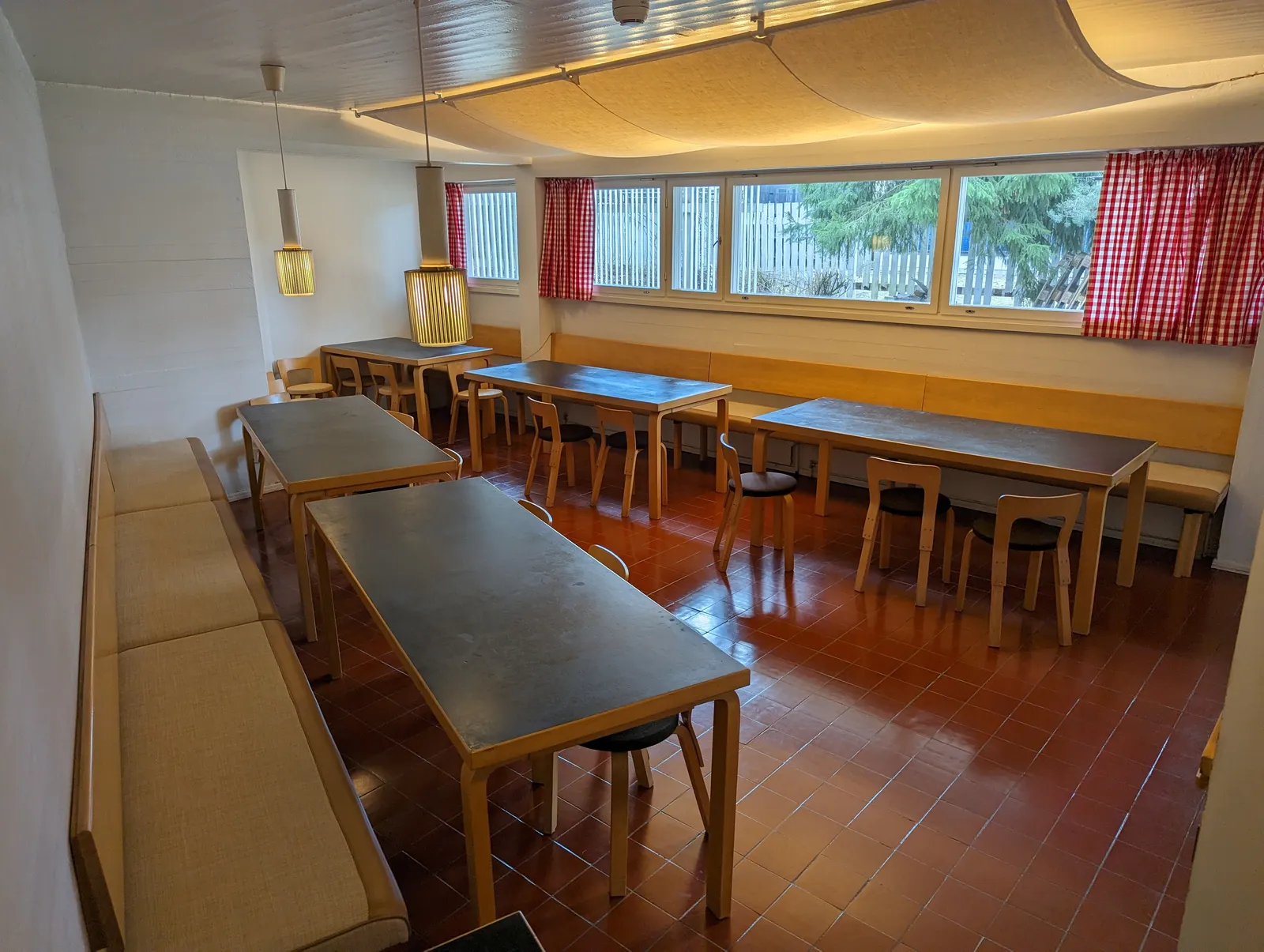
Artek makes the legs and edge-bands of Aalto's tables from Finnish birch. The top comes in birch, linoleum or laminate — 'materials that age gracefully over time and last across generations', in Artek's words. Its product pages name the laminate as high-pressure laminate and note that tables with an HPL top are made in Finland.
Artek also says what each top is for. Linoleum is 'the ideal surface for writing'; laminate is easy to clean and 'a slightly more robust option'. For the foldable Aalto table it puts it more plainly: 'easy-to-clean hard-wearing laminate is ideal for dining'.
Jean Prouvé's EM Table: HPL to the edge
Prouvé regarded himself as an engineer throughout his life, Vitra recalls, and was both the designer and the manufacturer of his ideas. The look of his EM Table, the company writes, follows structural principles and shows the flow of forces in its construction.
Vitra makes the EM Table with tops in solid wood or in HPL, and in oak veneer for the 2000 and 2400 mm lengths. The HPL top is 40 mm thick, with high-pressure laminate on both the surface and the edges, in ivory or asphalt.
The Eames Tables: built for a long life
The Eames Tables go back to bases Charles and Ray Eames developed in the 1940s; today's bases were created in the 1960s with the Soft Pad Chairs. For decades, Vitra writes, the tables have served communication, teamwork and interaction in offices, public spaces and homes, and 'high-quality materials guarantee an unusually long product lifespan'.
The dining versions come with solid wood tops. All the other models have tops either in HPL, with a distinctive rounded black plastic edge, or in wood veneer. Here laminate is part of the original: the Eames Office records that the first Eames contract-base tables, released in 1958, had plastic laminate tops, and wood veneer was added in the 1960s.
What the makers' choices say
Neither maker presents HPL as a cheap substitute. Artek places it beside birch and linoleum as one of three standard tops and calls it the more robust; Vitra offers it beside solid wood on Prouvé's table and as the main alternative to veneer on the Eames Tables, and lists it separately from melamine-faced tops. The reasons they give are the ones a table needs every day: it is hard-wearing, easy to clean and made to last.
Reading this against the Rushil range
A table top like the EM Table's is HPL pressed onto a board. Rushil Decor makes both parts: its investor presentation describes it as a manufacturer of MDF boards and laminates, and its decorative HPL is made from 0.5 to 1.8 mm. More than 200 of the 445 decors in the Rushil collections on this site are plain colours, from whites and ivories to dark greys; for a top without a separate edge, compact HPL is the other route.
Common questions
Which design classics are made with an HPL top?
Among others: Alvar Aalto's tables, which Artek offers in birch veneer, linoleum or high-pressure laminate; Jean Prouvé's EM Table, which Vitra makes with a 40 mm HPL top; and the Eames Tables, which Vitra offers with HPL tops with a rounded black edge. Of these, only the Eames tables had laminate tops from the start.
Is HPL the same as a melamine-faced top?
No. Vitra lists them as different options on the Eames Contract Tables. Melamine-faced board has a decorative paper fused to the board's surface; HPL is a laminate pressed at high pressure into a sheet, which is then bonded to a board or, as compact HPL, used on its own.
Can HPL cover the edges of a table too?
Yes. Vitra's HPL top for the EM Table has high-pressure laminate on both the surface and the edges.
Sources
- Artek — Aalto Table rectangularen
- Artek — Aalto Table 81Aen
- Artek — Aalto Table foldableen
- Vitra — EM Table — Jean Prouvé, 1950en
- Vitra — Eames Tables — Charles & Ray Eames, 1964/1968en
- Eames Office — Eames Contract Base Tableen
- Heritage Science, A. Jacquemain, K. Retko, L. Legan, P. Ropret, F. Waentig, V. Cattersel — Exploratory investigation of historical decorative laminates by means of vibrational spectroscopic techniquesMay 12, 2023 · en
- Rushil Decor — Earnings Presentation Q1 FY2026Aug 11, 2025 · en
Compiled for this site from the publications listed above. Summaries are in our own words, not quotations — read the originals for the full argument.