In short
- The laminate family behind worktops lines about 3 000 m² of particle detectors in CERN's CMS experiment: 912 resistive plate chambers with phenolic-melaminic electrodes.
- In an ageing campaign simulating the High-Luminosity LHC the chambers showed no drop in efficiency and no ageing effects, and ATLAS is installing about 1 000 new-generation chambers.
- Detector-grade HPL is a specialised product with a specified electrical resistivity; decorative and compact HPL share its paper-and-resin make-up, not that test.
How this review was put together
This article draws on open-access papers and conference proceedings from detector physics: on the resistive plate chambers of the CMS experiment (Costantini et al., Journal of Instrumentation, 2013; Kumari et al., Journal of Instrumentation, 2020; Eysermans et al., PoS EPS-HEP2017), on the ATLAS upgrade (Rocchi, PoS ICHEP2024), on a large HPL chamber built in Kolkata (two papers by Ganai et al., Journal of Instrumentation, 2016), on controlling the resistivity of HPL (Vitulo, Journal of Instrumentation, 2018) and on thin HPL electrodes (Lee et al., Nuclear Instruments and Methods A, 2025). The HPL in these detectors is a special grade with a specified electrical resistivity; the last section says what it shares with decorative and compact HPL, and what it does not.
A detector made of two plates and a gas
A resistive plate chamber is one of the simplest particle detectors in use: two parallel plates of highly resistive material, between 10⁹ and 10¹³ Ω·cm, a thin gas gap between them and a strong electric field across it. A charged particle crossing the gap sets off a small avalanche of electrons, and the signal is picked up on metal strips outside the plates. Relatively low cost, large areas and a time resolution of about half a nanosecond have made these chambers a standard way of detecting muons, in experiments including CMS and ATLAS at CERN's Large Hadron Collider, the Kolkata team summarises. The plates are made of glass or of what physicists call 'bakelite': phenolic high-pressure laminate.
3,000 square metres in CMS
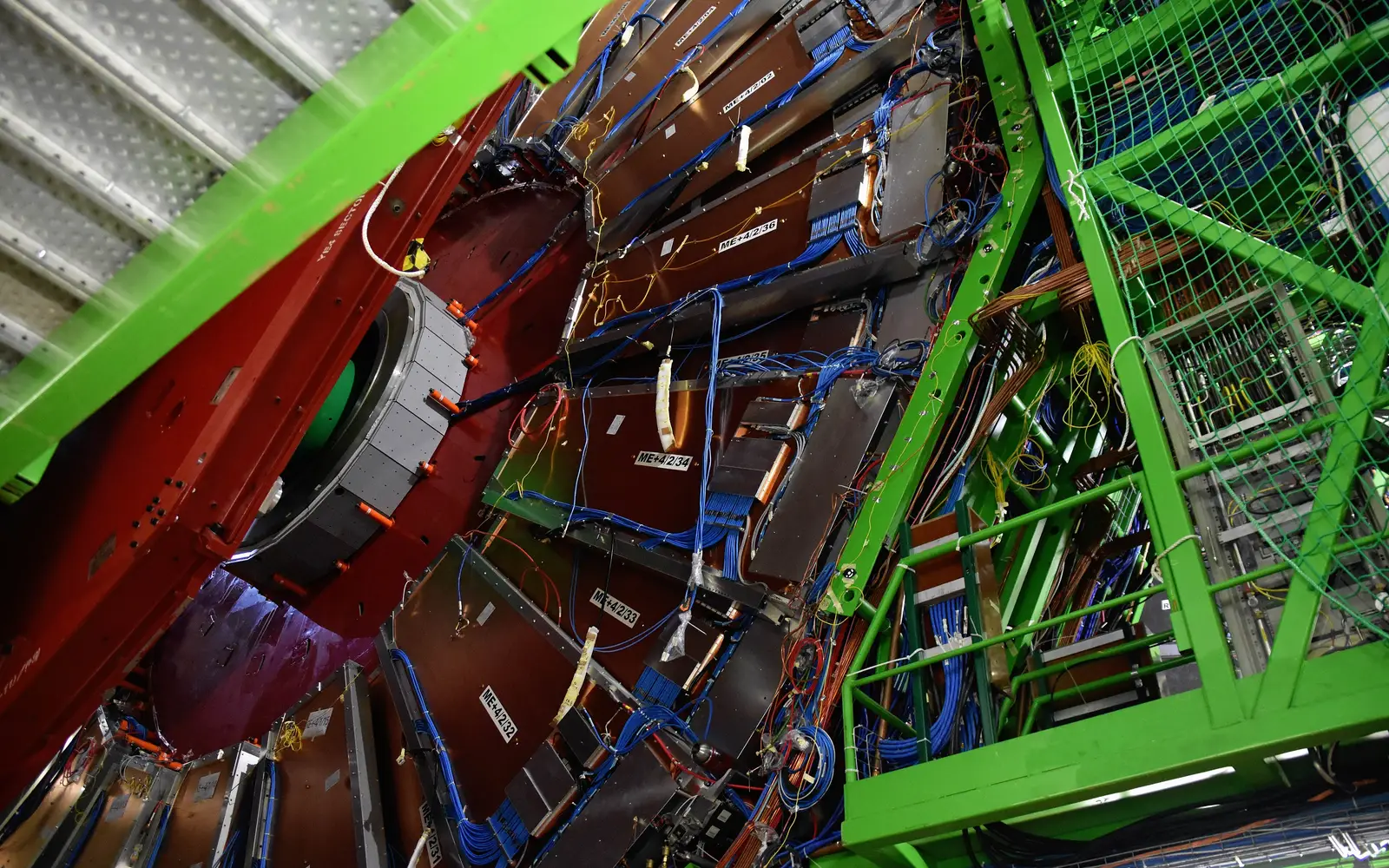
In the CMS experiment, 480 chambers in the barrel and 432 in the endcaps cover about 3,000 m². Each has two 2 mm gas gaps formed by phenolic-melaminic laminate electrodes with a bulk resistivity of the order of 10¹⁰ Ω·cm; the high voltage reaches them through a graphite coating on their outer faces. One detail will sound familiar to anyone who installs HPL: water vapour is added to the gas to hold its relative humidity at 40–50 %, so that the laminate's resistivity stays constant.
For the High-Luminosity LHC, CMS is adding improved chambers with 1.4 mm gaps and 1.4 mm electrodes, made of HPL specified at 0.9 to 3 × 10¹⁰ Ω·cm, about half the resistivity of the existing system, to cope with higher particle rates.
A thousand more chambers for ATLAS
ATLAS is installing about 1,000 new-generation chambers in the innermost barrel layer of its muon spectrometer. Their gas volume, Rocchi describes, consists of two HPL plates made of kraft paper layers impregnated with phenolic resin, the same build-up as the core of a compact panel, kept apart by polycarbonate spacers, with a graphite layer of calibrated resistivity outside and a thin coat of linseed oil inside. The existing ATLAS chambers have 2 mm gaps and 1.8 mm electrodes and are certified for ten ATLAS years at up to 100 Hz/cm²; the new, thinner design aims at a rate capability of the order of 10 kHz/cm².
Years of operation, and radiation
Will the laminate last? CMS ran an ageing campaign at CERN's Gamma Irradiation Facility, exposing chambers to a gamma flux equivalent to the High-Luminosity LHC period. Up to a background rate of 600 Hz/cm² and an integrated charge of 153 mC/cm², no drop in efficiency and no ageing effects were observed, Eysermans and colleagues report.
In Kolkata, a 240 × 120 cm chamber built from HPL bought on the local market, without the usual oil coating, ran for more than a year with a stable leakage current and bulk resistivity, an efficiency above 95 % and a time resolution of about 0.83 ns, the team reports. Large chambers of this kind are planned for neutrino experiments in India and at Fermilab.
Physicists keep refining the material
In Pavia, Vitulo embedded a gas electron multiplier foil inside a standard HPL panel and could vary its bulk resistance by more than an order of magnitude with the applied voltage. He describes HPL as a standard material of the furniture industry whose bulk resistivity is usually of no interest to its buyers; in a detector it governs how many particles per second the chamber can handle.
In Seoul and Bari, Lee and colleagues bonded 500 µm melamine-based HPL to graphite-coated polycarbonate to make thin electrodes for future colliders such as the FCC; a double-gap prototype responded uniformly to cosmic muons.
What a worktop shares with a detector, and what it does not
Detector-grade HPL is a specialised product: its resistivity is specified and measured, its inner surface is often oiled, and it is made for one purpose. A decorative panel or a compact worktop is not tested for bulk resistivity, and nothing here suggests it would work in a detector. What the physics shows is the character of the material family: large, flat sheets of paper and thermoset resin that stay stable for years in demanding service, can be made in quantity, and respond to humidity in a predictable way. That last point is why CMS controls the humidity of its gas, and why laminate guidance asks installers to let panels acclimatise before fixing.
Common questions
Is the HPL in particle detectors the same as decorative HPL?
It belongs to the same family, kraft paper impregnated with phenolic resin, often with a melamine surface, but it is a specialised grade whose bulk electrical resistivity is specified, of the order of 10¹⁰ Ω·cm in CMS. Decorative and compact HPL are not tested for that property.
How much HPL is in the CMS detector?
The CMS resistive plate chambers cover about 3,000 m²: 480 chambers in the barrel and 432 in the endcaps, each with two gas gaps between laminate electrodes.
Does HPL age under radiation?
In a CMS ageing campaign simulating the High-Luminosity LHC, chambers reached 153 mC/cm² of integrated charge at background rates up to 600 Hz/cm² with no drop in efficiency and no ageing effects observed. That is a result for the detectors as a whole, not a rating for furniture panels.
Sources
- Journal of Instrumentation 8, Costantini S., Beernaert K., Cimmino A., Garcia G., Lellouch J., Marinov A. et al. — Uniformity and stability of the CMS RPC detector at the LHCMar 25, 2013 · en
- Journal of Instrumentation 15, Kumari P., Lee K. S., Gelmi A., Shchablo K., Samalan A., Tytgat M. et al. — Improved-RPC for the CMS muon system upgrade for the HL-LHCNov 16, 2020 · en
- PoS — European Physical Society Conference on High Energy Physics 2017, Eysermans J., Pedraza Morales M. I., CMS Muon Group — Aging studies for the CMS RPC systemFeb 16, 2018 · en
- PoS — 42nd International Conference on High Energy Physics, Rocchi A., for the ATLAS Collaboration — Production and test of BI-RPC detectors for ATLAS Phase II upgradeDec 17, 2024 · en
- Journal of Instrumentation 11, Ganai R., Roy A., Agarwal K., Ahammed Z., Choudhury S., Chattopadhyay S. — Fabrication and characterisation of oil-free large High Pressure Laminate Resistive Plate ChamberApr 29, 2016 · en
- Journal of Instrumentation 11, Ganai R., Roy A., Shiroya M., Agarwal K., Ahammed Z., Choudhury S. et al. — Long term performance studies of large oil-free bakelite resistive plate chamberSep 13, 2016 · en
- Journal of Instrumentation 13, Vitulo P. — HPL-GEM: controlling High Pressure Laminates bulk resistivity with GEMsJun 4, 2018 · en
- Nuclear Instruments and Methods in Physics Research A (2025); open preprint arXiv:2506.03552, Lee K. S., Iaselli G., Jo Y., Kang M., Kim T. J. et al. — Development of thin high-pressure-laminate RPC electrodes for future high-energy experimentsJan 1, 2025 · en
Compiled for this site from the publications listed above. Summaries are in our own words, not quotations — read the originals for the full argument.