In short
- Rushil's compact laminate is tested to SEFA 3-2020, the recommended practice for laboratory work surfaces: most results are Level 0 (no effect) or Level 1 (excellent), and the overall result is within SEFA's acceptance criteria.
- Against everyday substances it returns grade 5 in all three EN 438 staining groups, and grade 5 for dry heat at 160 °C.
- Resistance differs from one reagent to the next, so read the SEFA report substance by substance. Rushil's catalogue also lists a dedicated laboratory line, LABORIS, in 12–19 mm.
Two standards, two different questions
Laminate data sheets carry two kinds of chemical result, and they answer different questions. EN 438-2 section 26 tests resistance to staining with three groups of everyday substances — the kind of thing a kitchen or an office surface meets. The compact grades return grade 5 for groups 1 and 2, where 5 is required, and grade 5 for group 3, where 4 is accepted.
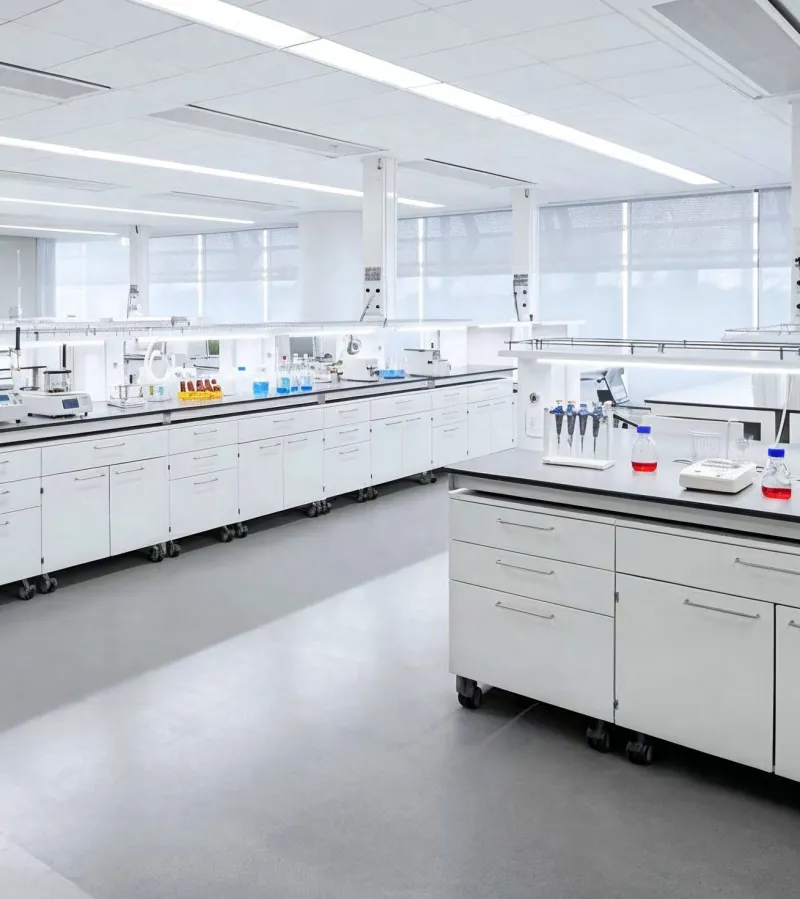
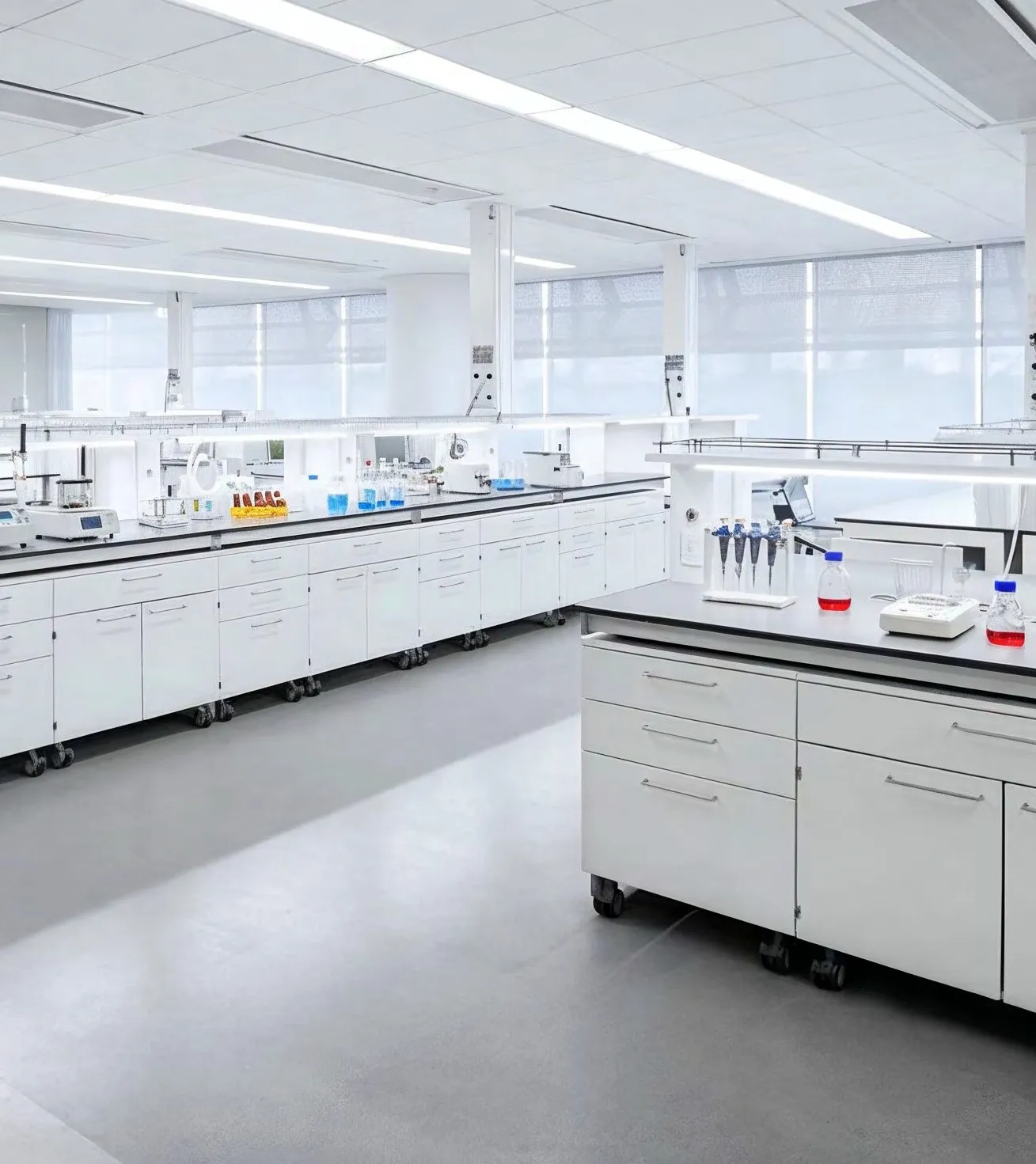
SEFA 3 is the North American recommended practice for laboratory work surfaces. Its chemical test exposes the surface to a defined list of laboratory reagents — acids, bases, solvents, indicators — and rates each one separately after exposure. That is the test a laboratory specification should reference.
What the result actually says
Rushil's compact laminate is tested to SEFA 3-2020, clause 2.1.1. The summary reports the majority of results at Level 0, no effect, and Level 1, excellent, and the overall result within SEFA's acceptance criteria.
Read that sentence carefully. 'The majority' means some reagents scored lower. For a teaching laboratory that rarely matters; for a laboratory that works with one specific aggressive reagent every day, it is the only thing that matters. The full report lists every reagent with its rating — ask for it, and check your own reagent list against it before specifying.
Heat, water and the edge
Laboratory benches see hot glassware, wet work and constant cleaning. Resistance to dry heat at 160 °C to EN 438-2.16 is grade 5, and immersion in boiling water to EN 438-2.12 produces a 0.4 % mass increase against a 2 % limit. As with any laminate, 160 °C is a laboratory condition, not permission to put a hot plate or a burner on the surface.
Compact has no substrate, so a cut-out for a sink or a service outlet exposes the same material as the face. That removes the failure mode of a bonded laminate, where water reaches the board at the cut-out.
Where compact is not the answer
Compact laminate is a strong general-purpose laboratory surface. Where work involves sustained exposure to concentrated acids, strong solvents or open flame, specialised surfaces — epoxy resin, ceramic, stainless steel — are the usual choice, and the reagent-by-reagent report is what tells you which side of that line your laboratory is on.
Rushil's Compact Verse catalogue also lists a dedicated laboratory line, LABORIS, in 12 to 19 mm. It is not part of the range on this site; ask whether it is available for your project.
Common questions
Is compact laminate chemical resistant?
Against everyday substances, yes — it achieves the top grade in the EN 438 staining tests. For laboratory reagents, resistance has to be read substance by substance in the SEFA 3 report, because the result differs from one chemical to another.
What do SEFA Level 0 and Level 1 mean?
They are the two best ratings in the SEFA chemical test: Level 0 is no effect on the surface, Level 1 is excellent. Lower levels describe increasing visible change. A product passes when its results fall within SEFA's acceptance criteria across the whole reagent list.
Can I get the full list of tested chemicals?
Yes — request the SEFA 3-2020 report through the quotation form. Send your own reagent list with the request, so the answer addresses the chemicals your laboratory actually uses.
Written for this site from manufacturer test reports. Not reproduced from any other source.