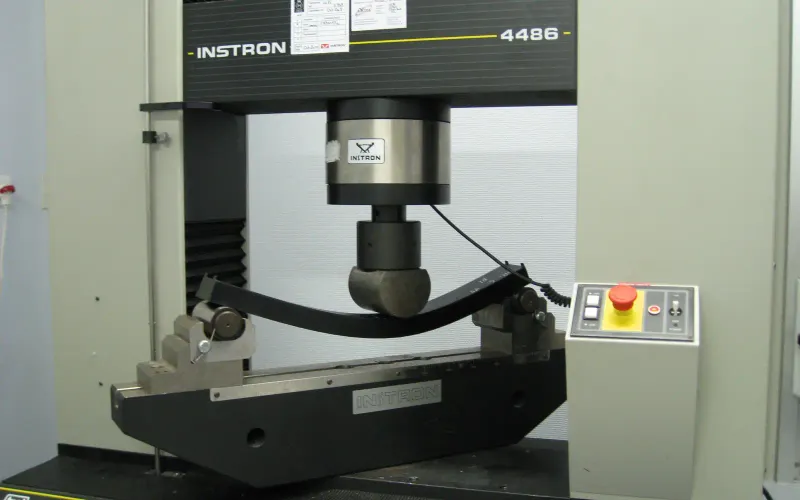
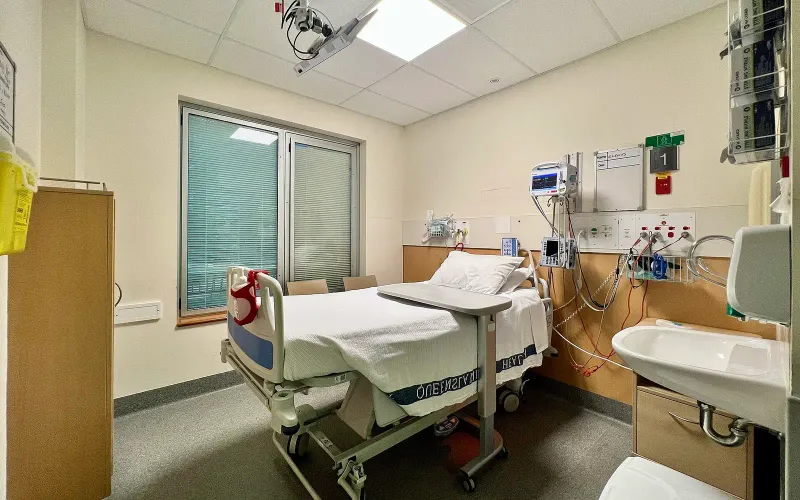
In short
- Researchers choose HPL when they need a known, reproducible material: surgeons in Groningen trained on HPL blocks because their stiffness is similar to that of cortical bone.
- TU Dresden built low-frequency sound absorbers with 3 mm HPL front panels, a Warsaw laboratory calibrates its slip tester on HPL, and Twente engineers built an intensive-care mobility device partly from laser-cut 6 mm HPL.
- HPL is also an ordinary laboratory worktop — a Simon Fraser University study used one — and, as on any bench, spills need prompt cleaning.
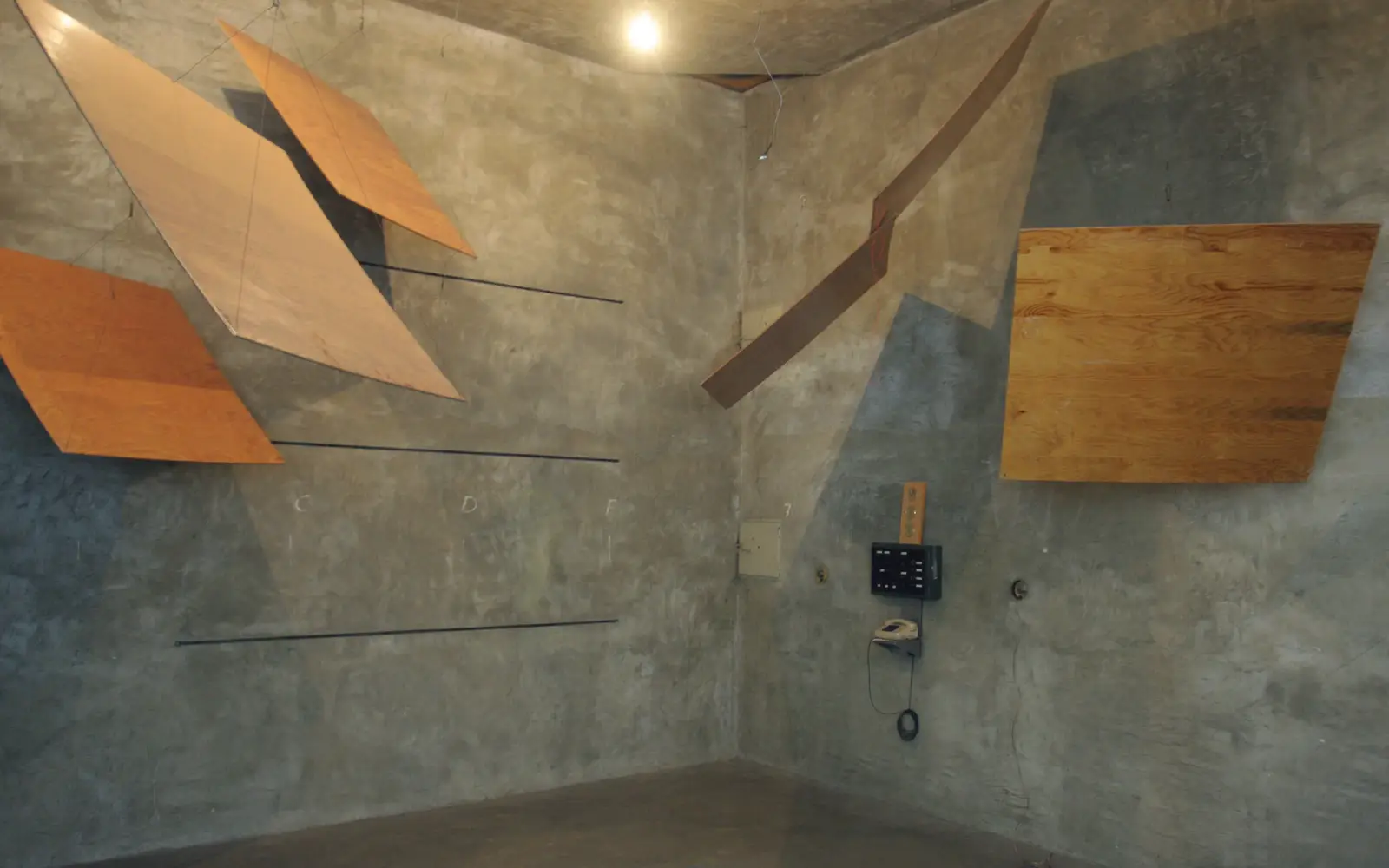
How this review was put together
This article collects seven open-access, peer-reviewed studies in which HPL is part of the experiment rather than its subject: from University Medical Center Groningen (Gareb et al., Scientific Reports, 2022), TU Dresden (Funk, Özer and Altinsoy, Applied Sciences, 2024), the Building Research Institute in Warsaw (Sudoł, Szewczak and Małek, Materials, 2021), the Universities of Hamburg and Freiburg (Knorr et al., Plant Methods, 2026), Nottingham Trent University (Morris et al., Materials, 2020), the University of Twente (van Galen et al., ASAIO Journal, 2024) and Simon Fraser University (Andreu et al., Royal Society Open Science, 2021). Where a paper gives its reason for choosing HPL, we say so; where it does not, we say that too.
A stand-in for human bone
Surgeons in Groningen wanted to know how accurately maxillofacial surgeons and residents tighten bone screws. They needed a reproducible test material, and chose predrilled HPL blocks of 36 × 36 mm because HPL has an elastic modulus similar to that of cortical bone: 1 mm blocks stood in for the thin bone of the midface, 6 mm blocks for the lower jaw. Five surgeons and twenty residents each inserted six screws of each size in two sessions two weeks apart. The experienced surgeons stayed within the reference torque range 95 to 100 % of the time, the residents 82 to 90 %.
A panel that absorbs low notes
Low-frequency sound is hard to absorb, because ordinary solutions need deep, bulky constructions. At TU Dresden, acousticians build Distributed Mode Absorbers instead: a thin vibrating front panel over a closed air cavity, compact enough to be built into furniture. The front panels of their prototypes are 3 mm HPL, 0.5 × 0.4 m, modelled with an elastic modulus of 10 GPa, a density of 1,470 kg/m³ and a loss factor of 2.54 %.
The team then carved an 'acoustic black hole', a tapered circular recess, into the HPL with a CNC machine of the kind used in furniture making. Measured on 42 units in the university's reverberation room, the carved panels absorbed more sound than plain ones, especially between 90 and 170 Hz.
A reference surface for slip testing
Before measuring how slippery granite floors with different surface finishes are, the Warsaw team calibrated its tribometer, a device that drags shoe-like sliders across a surface, on three reference surfaces: glass, HPL and ceramic tile. The paper does not explain the choice. A calibration reference is only useful if it behaves the same way every time it is measured, which is the property the choice implies.
In an MRI laboratory
In Hamburg and Freiburg, researchers built a climate-controlled growth chamber that lets living plants stay in a preclinical MRI scanner for hours, so that water transport can be imaged under stable conditions. The system had to be MR-compatible; its 800 W heater is housed in an enclosure of HPL plates with a 3D-printed frame. For parts inside the scanner bore, the team's rule was non-magnetic and, where possible, non-conductive materials.
Mould plate and prototype sheet
At Nottingham Trent University, researchers developing natural-fibre composites for medical imaging vacuum-infused their sheets on a flat HPL surface waxed with a release agent: the laminate served as the mould tool.
At the University of Twente, engineers built the prototype of ECMOve, a device that helps intensive-care patients on ECMO life support to get out of bed and move, partly from laser-cut 6 mm HPL, alongside 3 mm steel and 12 mm plywood.
The laboratory bench itself
At Simon Fraser University, chemists studying how nanomaterial spills spread around a laboratory used a section of the HPL countertop found in several of the university's labs as the spill surface. Their finding is about procedure, not material: residue picked up by a gloved finger was carried on through at least 12 successive surfaces, even from a spill that was seven days old.
What the choices have in common
Read together, the studies lean on a few properties. HPL's stiffness is known and repeatable enough to stand in for bone and to go into an acoustic model. It is flat enough to serve as a mould and, by implication, as a calibration reference. It can be laser-cut and carved on an ordinary furniture CNC machine. And it is the everyday work surface of many laboratories. None of these studies tested Rushil panels; physicists go further still, as a separate article on HPL in particle detectors describes.
Common questions
Why is HPL used as a bone model?
Because its elastic modulus is similar to that of cortical bone, the Groningen team explains, and blocks of a given thickness are reproducible. They used 1 mm and 6 mm HPL blocks to simulate thin and thick bone in screw-torque tests.
Can HPL absorb sound?
As a thin vibrating panel over an air cavity, yes, at low frequencies. TU Dresden's absorbers with 3 mm HPL front panels absorb low-frequency sound, and carving a tapered recess into the panel improved absorption especially between 90 and 170 Hz.
Is HPL used as a laboratory worktop?
Yes. In the Simon Fraser University study, an HPL countertop found in several of the university's laboratories served as the test surface. Spills on any worktop still need prompt cleaning: residue was carried through at least 12 successive contacts.
Sources
- Scientific Reports 12, Gareb B., van Munster V. D. M., Dijkstra P. U., Bos R. R. M., Vissink A., van Bakelen N. B. et al. — Reliability and accuracy of the torque applied to osteosynthesis screws by maxillofacial surgeons and residentsAug 24, 2022 · en
- Applied Sciences 14(4), Funk M., Özer M. S., Altinsoy M. E. — Improving Low-Frequency Panel Absorbers with Two-Dimensional Acoustic Black HoleFeb 6, 2024 · en
- Materials 14(5), Sudoł E., Szewczak E., Małek M. — Comparative Analysis of Slip Resistance Test Methods for Granite FloorsFeb 27, 2021 · en
- Plant Methods 22, Knorr N., Rovedo P., Leupold J., von Elverfeldt D., Hesse L., Bär S. et al. — In-bore climate control chamber for magnetic resonance imaging of living plantsJul 7, 2026 · en
- Materials 13(7), Morris R. H., Geraldi N. R., Stafford J. L., Spicer A., Hall J., Bradley C. et al. — Woven Natural Fibre Reinforced Composite Materials for Medical ImagingApr 4, 2020 · en
- ASAIO Journal 70(5), van Galen D. J. M., Meinders Q., Halfwerk F. R., Arens J. — ECMOve: A Mobilization Device for Extracorporeal Membrane Oxygenation PatientsFeb 20, 2024 · en
- Royal Society Open Science 8(8), Andreu I., Ngo T. M., Perez V., Bilton M. W., Cadieux K. E. C., Paul M. T. Y. et al. — Contact transfer of engineered nanomaterials in the workplaceAug 18, 2021 · en
Compiled for this site from the publications listed above. Summaries are in our own words, not quotations — read the originals for the full argument.