In short
- Real timber cracks, swells, twists and greys outdoors; wood-decor exterior HPL keeps its colour, rated 4–5 on the grey scale after 3 000 hours of artificial weathering against a required 3.
- Fire-retardant HPL sits higher on the fire scale: KLADS EDF is classified B-s1,d0 at 6 mm, while solid wood cladding on battens is D-s2,d0.
- Glazed timber needs its coating renewed regularly; wood-look HPL never develops a weathered patina — and neither material meets an A1 or A2 requirement.
How this review was put together
This article draws on Baunetz Wissen's summary of the German carpentry trade's technical rule for timber cladding; on two Lignum Compact guides from the Swiss timber industry association, Lignum; on Commission Decision 2006/213/EC, which fixes the fire classes of solid wood cladding in the EU; and on the Welsh Government's Advice Note 22 for HPL. Each point is attributed, and the sources are listed at the end.
Timber changes — that is the deal
Baunetz Wissen, summarising Fachregel 01 of the German carpentry trade, is frank: cracking, swelling and shrinkage, twisting, cupping and resin bleeding cannot be avoided outdoors. The aim of good design is to keep them to an acceptable level while the cladding stays stable and serviceable. Durability depends above all on the species — larch, Douglas fir and oak among native woods, with spruce and fir also proven — and every timber component should be assigned a use class to DIN 68800-1 at the design stage.
The rule covers cladding up to 10 m above ground; for higher façades its principles apply by analogy. Baunetz Wissen also reminds designers that cladding and any insulation behind it are legally part of the external wall, so fire, heat, sound and condensation protection all have to be checked against the building code.
Grey, brown or painted
Lignum describes three kinds of timber façade: artificially greyed, surface-treated and untreated. Untreated wood works if the construction is right and the boards go up at a moisture content of 14 % ± 2 %. Sunlight then breaks down the lignin, rain washes it out, and the lighter cellulose left behind is colonised by harmless fungi — the surface turns grey. Balconies, cornices and window sills shelter parts of the wall, so the greying is uneven at first and evens out only partly, after several years.
There are ways to manage it, each with a cost:
- Pre-greying: specialist makers accelerate natural greying with enzymes, which takes about six months; greying stains even out the colour change, though protected, sunny areas tend to turn brown anyway.
- Thin glazes: they protect only partly against UV, do not stop moisture uptake, lose their effect after a few years and need regular maintenance — Lignum calls them unsuitable for large, exposed façades.
- Opaque paints: they block sunlight, but any crack traps moisture; dark colours can heat the façade to 70 °C and crack the wood. Lignum recommends boards about 24 mm thick and coats no thicker than 60 µm.
Fire: two combustible materials, two different classes
Commission Decision 2006/213/EC classifies solid wood cladding without further testing. Boards with a mean density of at least 390 kg/m³ and the minimum thicknesses the Decision sets, mounted on battens with an open air gap behind, are class D-s2,d0 — the usual case for a ventilated timber façade.
HPL is combustible too, but its fire-retardant grades sit higher on the scale: the Welsh Government's Advice Note 22 says they typically reach B-s1,d0, while panels without fire retardant can be C or D depending on thickness. Neither material is non-combustible. Where rules demand A1 or A2 cladding — as Wales announced in 2019 for new residential buildings with a storey at 18 m or more — neither timber nor HPL is an option.
Wood-look HPL: what it is, and what it is not
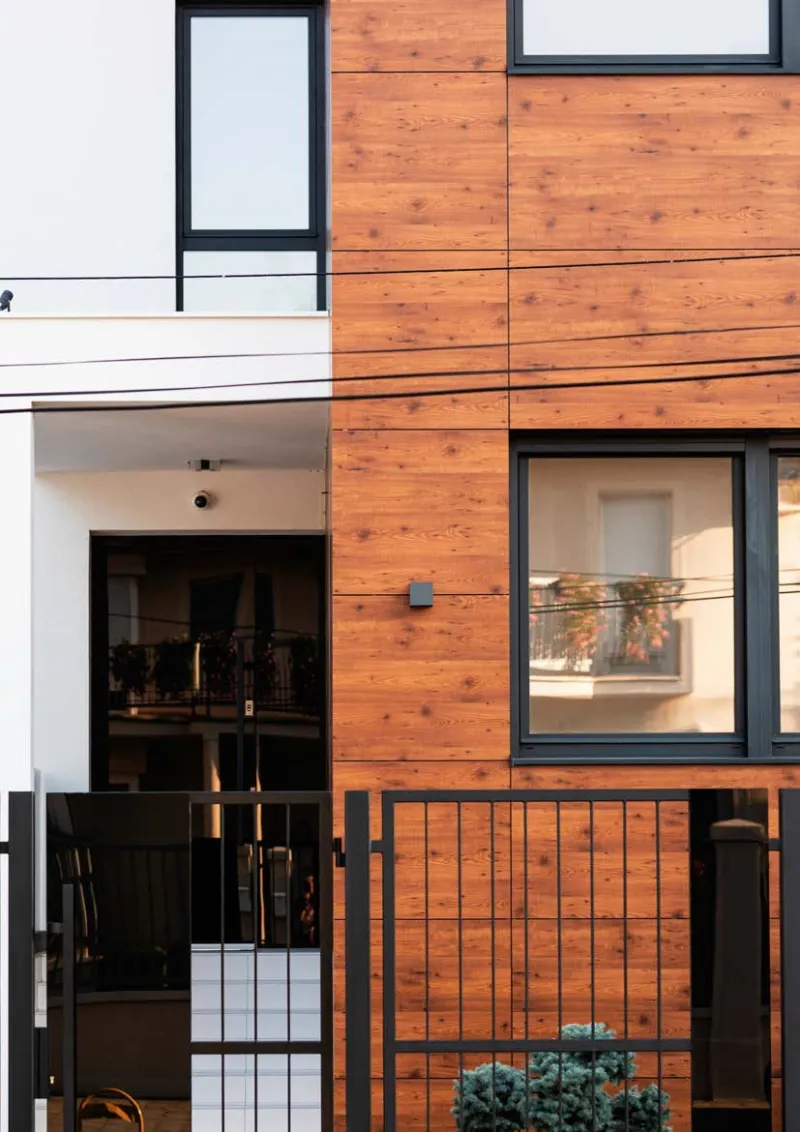
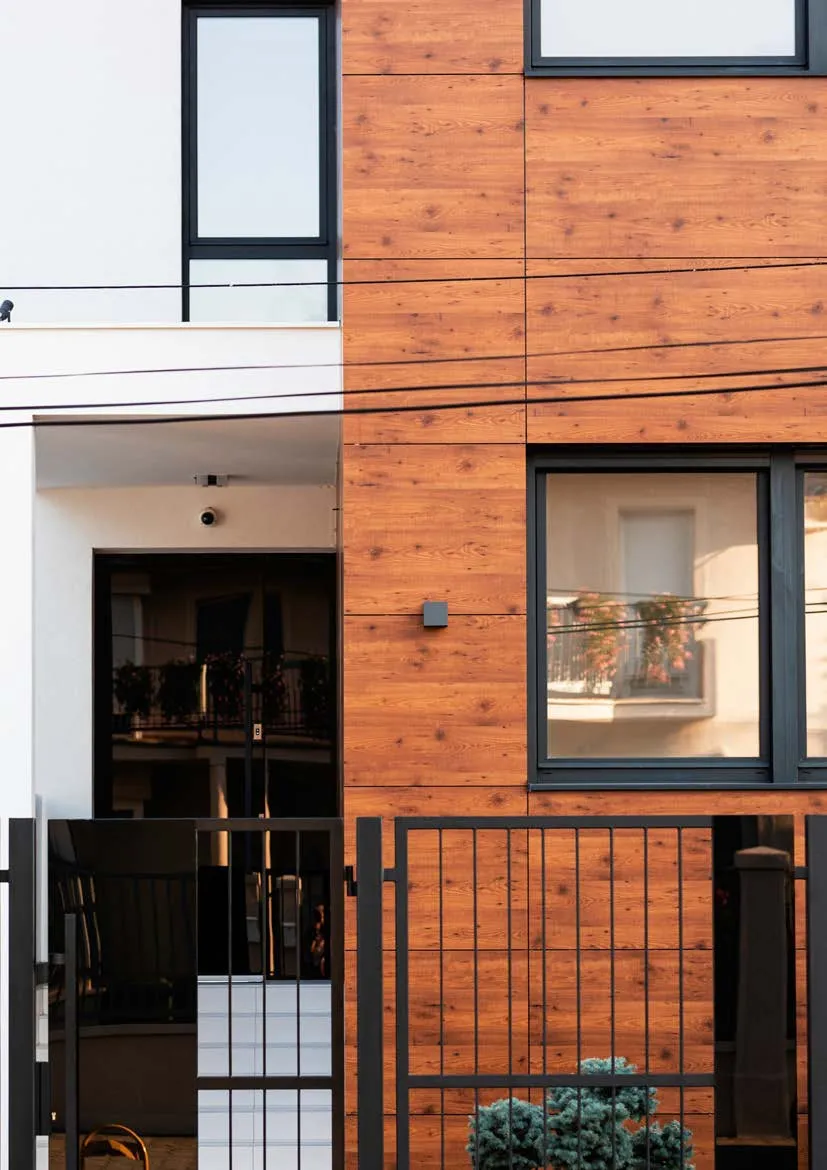
A wood-decor exterior laminate prints the wood on paper and seals it under a weather-resistant surface, so the colour is meant to stay. Rushil's exterior compact was rated 4–5 on the grey scale after 3000 hours of artificial weathering to EN 438-2, against a required 3. There is no greying to plan around, no glaze to renew and no board-to-board colour variation from uneven exposure.
It is not wood. It will not develop a patina, and it does not behave like timber — it moves with temperature and humidity in its own way and is fixed like any HPL panel, with one fixed point and oversized holes. For an architect who wants the silver-grey of weathered larch, only larch will do; for one who wants the colour on the drawing to be the colour in ten years, the laminate is the more predictable choice.
Reading this against the Rushil range
KLADS, Rushil's exterior compact to EN 438-6, includes wood decors and is documented from 6 to 12 mm in formats up to 1830 × 4330 mm. Its fire-retardant EDF grade is classified B-s1,d0 at 6 mm. The weathering result quoted above was measured on the 6 mm panel. Fixing follows our guide to detailing HPL façades.
Common questions
Does wood-look HPL turn grey like real wood?
No. Exterior grades are made to keep their colour; Rushil's exterior compact rated 4–5 on the grey scale after 3000 hours of artificial weathering to EN 438-2. That also means it will never develop the patina of weathered timber.
What fire class is a timber façade?
Under Commission Decision 2006/213/EC, solid wood cladding of at least 390 kg/m³ on battens with an open air gap is class D-s2,d0 without further testing. Fire-retardant HPL typically reaches B-s1,d0. Neither meets an A1 or A2 requirement.
How often does a glazed timber façade need maintenance?
Lignum says thin glazes lose their protective effect after a few years and must be renewed regularly, which makes them unsuitable for large, exposed façades. Untreated timber needs no coating maintenance but greys unevenly at first.
Sources
- Baunetz Wissen — Außenwandbekleidungen aus Holzde
- Lignum — Lignum Compact: Rivestimento delle facciate in legno – Tipologia di superficieit
- Lignum — Lignum Compact: Protezione del legno nell’ediliziait
- EUR-Lex — Official Journal of the European Union — Commission Decision 2006/213/EC establishing the classes of reaction-to-fire performance for wood flooring and solid wood panelling and claddingMar 6, 2006 · en
- Welsh Government — Advice Note 22 – Use of High Pressure Laminate Panels in external wall systemsAugust 2019 · en
Compiled for this site from the publications listed above. Summaries are in our own words, not quotations — read the originals for the full argument.