In short
- A table is tested as a whole — to EN 12521 for the home and EN 15372 for contract use, both revised in 2023, with the methods in EN 1730 — so a compact top does not exempt the table from its own test.
- The stability test loads the top 50 mm from the edge in the position most likely to tip; EN 15372 places restaurants, bars and canteens at level 2.
- Rushil's interior compact brings strong panel data to the design: flexural strength of 136.1 MPa against a required 80, a modulus of 15 336 MPa and screw pull-out of 3 514 N.
How this review was put together
This article draws on technical articles by CATAS — which the Italian trade magazine Ambiente Cucina calls the most important European laboratory for furniture testing: Maurizio Marussi's review of the 2023 table standards, a June 2026 note on table stability, and a May 2026 note on the new outdoor furniture standards. The scope of EN 15372 is taken from the standard's entry at DIN Media. The sources are listed at the end.
Which standard applies
Tables for the home are covered by EN 12521, whose new version was published in November 2023 and replaces the 2015 edition. Tables for non-domestic use are covered by EN 15372, published in December 2023 to replace the 2016 edition. Both set safety, strength, durability and stability requirements; the test methods themselves are in EN 1730.
EN 15372:2023 applies to all non-domestic tables, glass-topped ones included, but not to office work tables and desks, tables for educational institutions, or outdoor tables, which have their own European standards, nor to professional laboratory or industrial workbenches. Outdoor tables are covered by EN 581-3, whose new version CEN made available on 20 May 2026.
Stability: where the table is weakest
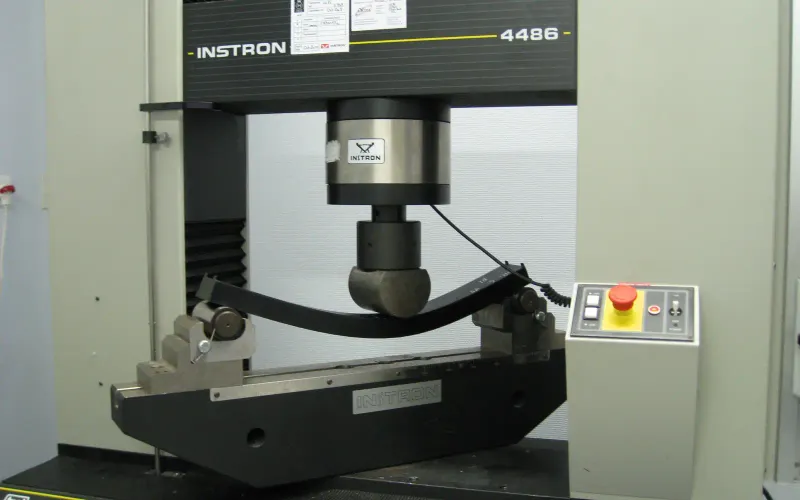
CATAS describes the vertical-load stability test of EN 1730. The table is tested in the configuration in which it is most likely to tip; levelling feet are set 5 mm short of their maximum extension. The load is applied 50 mm in from the edge of the top, where tipping is most likely — CATAS advises checking along the whole edge — and the table must not tip over.
The load depends on the length of the top. The requirement standard gives a minimum value V1 for tops shorter than 800 mm and a maximum V2 for tops longer than 1 600 mm, with a linear formula in between. For domestic tables, EN 12521:2023 sets V1 = 200 N and V2 = 400 N, so a 1 400 × 800 mm table 740 mm high is tested at 350 N. Tables higher than 950 mm are tested at 50 % of the calculated load.
Pedestal tables, with a single central base, are the ones most at risk, because the support is far from the edge of the top. Drawers are tested open and loaded according to their volume — for domestic tables 0.2 kg per dm³, so a 360 × 365 × 65 mm drawer carries 1.7 kg.
Top deflection and test levels
Marussi points to a change that matters for thin tops. In EN 15372:2023 the deflection test of the top, to EN 1730, remains in an informative annex, but the maximum deformation now depends on the distance between supports and on the material of the top, in addition to the load of 1.5 kg per dm².
The same standard's Annex C, also informative, links three test levels to typical uses:
- Level 1, light: hotel rooms, churches — short use and low loads.
- Level 2, general: hotels, libraries, offices other than work tables, bars, restaurants, public waiting rooms, banks, meeting rooms, canteens.
- Level 3, severe: night clubs, police stations, public areas of hospitals, casinos, sports changing rooms, prisons, barracks.
What else changed in 2023
Marussi lists the other revisions, for domestic and non-domestic tables:
- New methods and limits for finger entrapment and crushing in both standards.
- EN 12521 now also covers tops not fixed to the frame, except trestle tables; EN 15372 excludes them, along with professional laboratory tables.
- Height-adjustable tables: a durability test of 5 000 cycles — at least 25 or 50 kg on the top for domestic tables, 25 to 75 kg across the three levels for non-domestic ones.
- Domestic tables with castors: a durability test of 1 000 cycles with 20 kg on the top.
- Domestic tables: a vertical fatigue test for cantilevered tables up to 600 mm high or 0.3 m², and a new category of "delicate tables" up to 0.30 m², tested with lower loads and sold with warnings.
Outdoor tables
CATAS summarised the new EN 581-3 in May 2026: revised tests for glass tops; more table types and a threshold raised from 0.25 to 0.30 m²; a changed load for the horizontal strength test at camping level; a clarified definition of cantilevered tables; an added vertical strength test for cantilevered and pedestal tables; an added impact test; and new definitions of camping, domestic and contract tables. The 2017 edition will be withdrawn as each country adopts the new one, within six months.
Reading this against the Rushil range
The TOPAZ and VAULT data sheets report the same EN 438-4 test results for Rushil's interior compact: flexural strength of 136.1 MPa against a required 80, a flexural modulus of 15 336 MPa against a required 9 000, a density of 1.47 g/cm³, and screw pull-out of 3 514 N to ISO 13894-1. These are panel properties. The table standards test the assembled table, so stability, strength and deflection depend on the table maker's design — the span between supports, the frame and the fixings — and are proved on the table itself.
For outdoor tables, ask for an exterior grade classified to EN 438-6; interior compact is classified to EN 438-4 for indoor use.
Common questions
Does a table with a compact top need its own test?
Yes. EN 12521 and EN 15372 test the assembled table. Panel data such as flexural strength and modulus help the design, but stability, strength and deflection are proved on the table.
Which test level applies to a restaurant table?
EN 15372:2023's informative Annex C places restaurants, bars and canteens at level 2, general; night clubs and sports changing rooms at level 3, severe.
How is the stability load calculated?
V1 applies to tops up to 800 mm long and V2 from 1 600 mm, with linear interpolation in between. For a 1 400 mm domestic table (V1 = 200 N, V2 = 400 N) the load is 350 N, applied 50 mm from the edge.
Sources
- CATAS, Maurizio Marussi — Tables for domestic and non-domestic use: new 2023 versions publishedJanuary 2024 · en
- CATAS — Quali fattori considerare per verificare la stabilità di un tavolo?Jun 30, 2026 · it
- CATAS — In arrivo due novità normative per l’arredo per esternoMay 30, 2026 · it
- DIN Media — DIN EN 15372:2024-03 — Furniture: strength, durability and safety; requirements for non-domestic tablesMarch 2024 · en
- Ambiente Cucina — Catas, focus su ecodesign e sicurezzaNov 25, 2024 · it
Compiled for this site from the publications listed above. Summaries are in our own words, not quotations — read the originals for the full argument.