In short
- Peer-reviewed studies measured compact HPL at 105–110 MPa in bending — level with birch plywood and three to four times MDF and particleboard. Rushil's data sheets report 136.1 MPa.
- In furniture joints the adhesive decides: with the right one compact made the stiffest glued corner in a 2023 study, with another the weakest — so test the adhesive first.
- Scratch and heat resistance depend on how fully the melamine resin is cured, and researchers are developing near-infrared checks on the production line and bio-based resins with lignin.
How this review was put together
This article summarises six open-access, peer-reviewed papers: two furniture-engineering studies that tested compact HPL beside wood-based panels, from Sofia (Petrova, Jivkov and Yavorov, Materials, 2023) and Rzeszów (Szwajka, Zielińska-Szwajka and Trzepieciński, Materials, 2024); a German study of how the cure of melamine surfaces is measured (Meder, Mai and Lukowsky, Materials, 2025); an Austrian study of curing phenolic laminate cores (Zimmerleiter et al., Analytical and Bioanalytical Chemistry, 2025); and two papers on bio-based resins for HPL, from Prague (Němec, Hájková and Hýsek, Materials, 2023) and Austria (Billich et al., ACS Omega, 2025). Where Rushil's own test results are set beside them, the text says so.
Paper and resin, cured for good
Compact HPL is paper and resin. Kraft paper impregnated with phenol–formaldehyde resin forms the core; decor papers impregnated with melamine–formaldehyde form the faces. In the press both resins cure into thermosets, networks of cross-linked molecules that do not melt again, and the layers fuse into one solid sheet. The phenolic resin turns into a rigid, cross-linked and insoluble solid, the Austrian team explains; melamine resins are hard, durable and resistant to heat and to most chemicals, strong acids excepted, the German authors summarise.
As strong as birch plywood, three times MDF
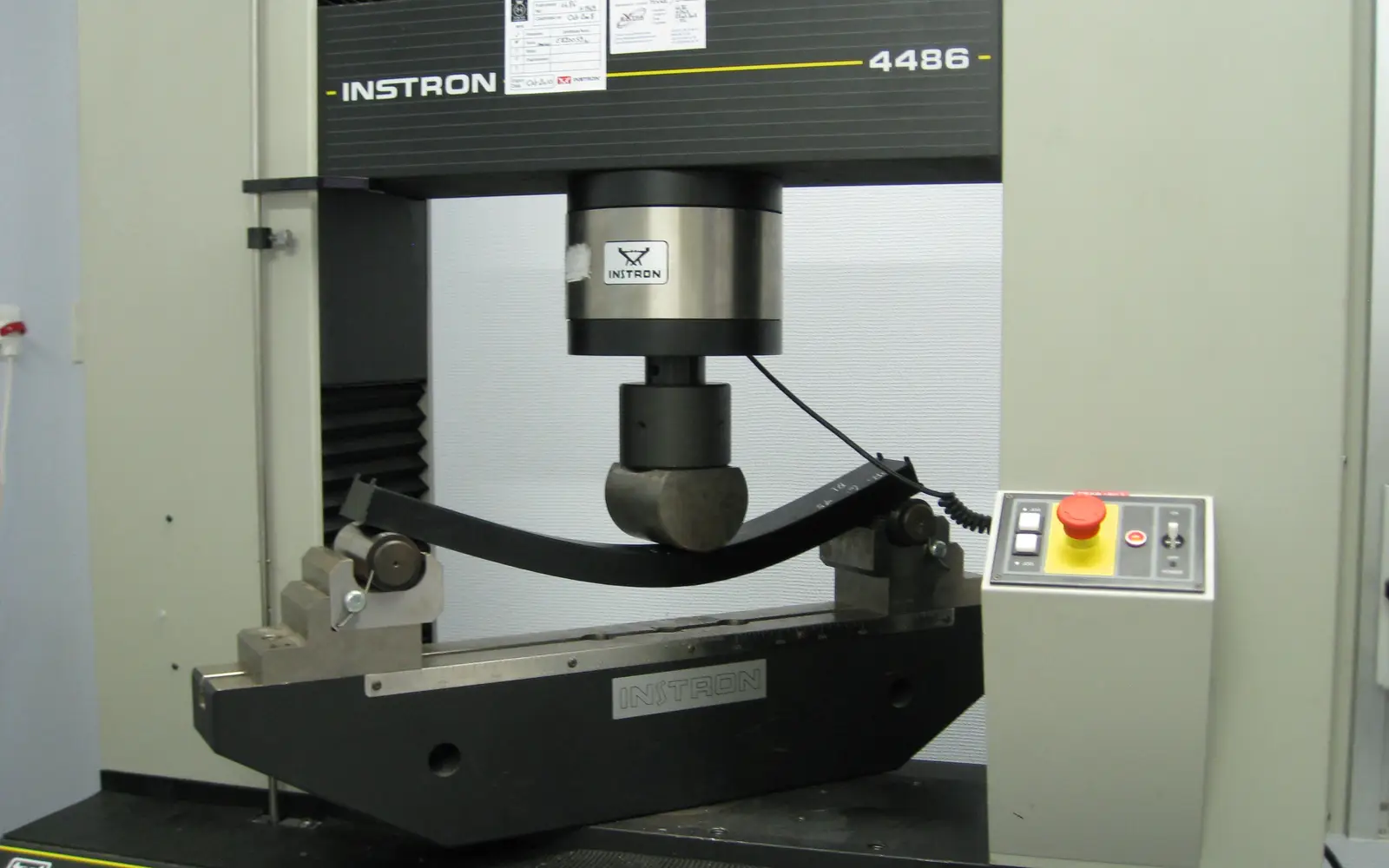
Two independent studies measured compact HPL beside the panels furniture makers use every day. In Sofia, 10 mm compact had a bending strength of 104.9 N/mm² and a modulus of elasticity of 8,886 N/mm² at a density of 1,490 kg/m³: level with 9 mm birch plywood measured across the face grain (103.9 N/mm²), and three to four times 10 and 12 mm MDF (31–35 N/mm²) and 12 mm laminated particleboard (26.1 N/mm²). In Rzeszów the HPL board reached 110 MPa and 9,250 MPa at 1,470 kg/m³, against 85 MPa for plywood, 38 for MDF and 12 for chipboard.
For reference, the EN 438-4 compact grades in Rushil's TOPAZ and VAULT data sheets report a flexural strength of 136.1 MPa and a modulus of 15,336 MPa to EN ISO 178, against requirements of at least 80 and 9,000 MPa, at a density of 1.47 g/cm³. The samples and laboratories differ from the two studies, so the comparison is indicative only.
Thin furniture and the glued corner
The Sofia team then built mitred L-shaped corner joints, the detail behind much thin-panel furniture, from each material. Compact produced both extremes. With an adhesive that formed a highly elastic seam it made the stiffest joint in the study, 4,992 N·m/rad against 3,277 for the best wood-based joint, and carried 20.8 N·m in bending without coming apart even after its peak load. With another adhesive the same compact failed suddenly at 5.95 N·m, the weakest result of all.
In bending capacity the wood-based joints glued with PVA did better, up to 44.2 N·m for MDF faced with HPL. The conclusion for compact is practical: the panel is strong enough for thin furniture, but its joints are only as good as the adhesive, and the three adhesives tested changed the bending capacity by a factor of 3.5. Test the adhesive on the panel before production.
The price of density: cutting forces
Strength has a flip side at the machine. Drilling 10 mm holes, the Rzeszów team measured the unit cutting resistance of each material: 248 N/mm² for HPL, against 138 for plywood, 72 for chipboard and 56 for MDF. The cutting torque on HPL was four to six times that on MDF. This is why compact calls for sharp carbide or diamond tooling and lower feeds per tooth, as the machining guidance on this site sets out.
The surface is made in the press
In the press, the German authors explain, the pre-cured resin liquefies at 130 to 190 °C and cross-links; part of the curing goes on while the sheet cools. The degree of cure decides the surface. Undercured melamine resists chemicals and abrasion poorly, stains easily and can look cloudy; overcured surfaces are prone to edge breakouts and cracks, which may appear only after installation. Comparing four ways of measuring cure on 18 panels, the team found the industry's common Kiton test the least reliable at spotting overcure, while near-infrared spectroscopy and two new hydrolysis methods could tell tolerable overcure from problematic overcure.
The phenolic core is measured the same way. The Austrian team followed the drying and curing of phenolic resin on kraft paper by thermal analysis and spectroscopy, then installed a near-infrared sensor on a production line: 18,500 spectra correlated closely with laboratory measures of volatile content and resin flow, the usual proxies for the cure of semi-finished phenolic laminate. Resistance to scratching, staining and crazing is what the cure decides; Rushil's compact data sheets report grade 5, the top of the EN 438 scale, for all three.
Where the research is heading
Laboratories are working on the same panel with less fossil phenol. In Prague, adding 1 % kraft lignin, a by-product of pulp mills, to a commercial phenolic resin gave laminates with a bending strength of 72.4 MPa and 3.3 % thickness swelling after immersion, mostly not statistically different from those made with commercial resin. In Austria, bio-based resins made from carbohydrates wetted kraft papers, including papers with recycled fibre, about as well as commercial phenolic resin, though they penetrated the paper differently. Neither is yet a product, but both point the same way.
Common questions
Is compact HPL stronger than MDF or particleboard?
In bending, yes. Two peer-reviewed studies measured 105 to 110 MPa for compact HPL against 31 to 38 MPa for MDF and 12 to 26 MPa for particleboard; birch plywood came closest. Compact is also about twice as dense.
Can compact HPL be glued in furniture joints?
Yes, but the adhesive decides. In a 2023 study of mitred corner joints, three adhesives gave compact joints bending capacities from 6 to 21 N·m, and one gave the stiffest joint of all the materials tested. Test the adhesive on the panel before production.
What makes an HPL surface resistant to scratches and heat?
Mostly the cure of the melamine resin. Research summarised by Meder and colleagues links undercure to poor resistance to chemicals and abrasion and overcure to cracking, which is why producers measure the degree of cure.
Sources
- Materials 16(21), Petrova B., Jivkov V., Yavorov N. — Possibilities for Efficient Furniture Construction Made of Thin and Ultra-Thin Materials by Using Mitre JointsOct 25, 2023 · en
- Materials 17(9), Szwajka K., Zielińska-Szwajka J., Trzepieciński T. — Experimental Analysis of Smart Drilling for the Furniture Industry in the Era of Industry 4.0Apr 26, 2024 · en
- Materials 18(1), Meder M., Mai C., Lukowsky D. — Evaluation of Four Methods to Determine the Degree of Cure of Melamine-Based Direct Pressed Laminates on ParticleboardsDec 30, 2024 · en
- Analytical and Bioanalytical Chemistry 417, Zimmerleiter R., Kovacevic J., Leitner G., Wimberger D., Lager D., Friedl S., Pleschutznig E., Barz T., Brandstetter M. — Curing reaction kinetics of paper-based phenolic resin laminates — from laboratory measurements to inline quality controlJul 3, 2025 · en
- Materials 16(7), Němec M., Hájková K., Hýsek Š. — Paper-Based Laminates Impregnated with a Hybrid Lignin-Phenol-Formaldehyde ResinMar 27, 2023 · en
- ACS Omega 10(32), Billich E., Hogger E., Sumerskii I., Sailer-Kronlachner W., Rosenfeld C., Duller M., Blum C., Potthast A., van Herwijnen H. W. G. — Wettability of Kraft Paper with Biobased Impregnation Resins for the Production of High-Pressure LaminatesAug 8, 2025 · en
Compiled for this site from the publications listed above. Summaries are in our own words, not quotations — read the originals for the full argument.