In short
- Two Pritzker laureates took laminate seriously: Frank Gehry broke colour-core laminate into translucent shards for his fish lamps, first shown at Gagosian in 1984 and now kept by SFMOMA and the Philadelphia Museum of Art.
- Robert Venturi and Denise Scott Brown wrapped chairs for Knoll in laminate printed with their 'Grandmother' pattern; MoMA holds the Queen Anne chair and the V&A the Chippendale.
- Rushil's decorative HPL, from 0.5 to 1.8 mm, carries printed surfaces across the 445 decors in the collections on this site.
How this review was put together
This article draws on the collection records of SFMOMA, the Philadelphia Museum of Art, the Museum of Modern Art in New York and the Victoria and Albert Museum in London; on the Jewish Museum in New York's 2010 exhibition release; on Gagosian's 2013 press release for 'Frank Gehry: Fish Lamps'; and on the Pritzker Architecture Prize. Each point is attributed, and the sources are listed at the end.
An invitation in 1983
To promote the launch of a new colour-core laminate — one whose colour runs through the whole sheet — an American manufacturer invited architects in 1983 to show the material's character through their own designs, SFMOMA records. The Philadelphia Museum of Art describes the same invitation: Gehry and other architects were asked to use the new material in inventive ways. Gehry went on to win the Pritzker Architecture Prize in 1989; Robert Venturi, whose laminate-covered chairs appear below, won it in 1991.
A sheet that broke into scales
Gehry had already decided to show off the laminate's integral colour and translucency when he accidentally broke a piece, SFMOMA explains. It shattered into rough, scale-like fragments of varying opacity and shading; joined together and lit from behind, they looked like the swelling, tapering body of a fish.
He made a prototype and turned to New City Editions, the studio next door, to fabricate the lamps, each of which he designed and approved, the Jewish Museum recounts. A wooden model was made, a wire armature was stretched over it, cut free and resoldered, and the laminate shards were glued on one by one; some lamps used larger shards for a base that hid the bulbs. About thirty were made between 1984 and 1986, and the first were shown in 1984 at Gagosian in Los Angeles.
'The fish is a perfect form'
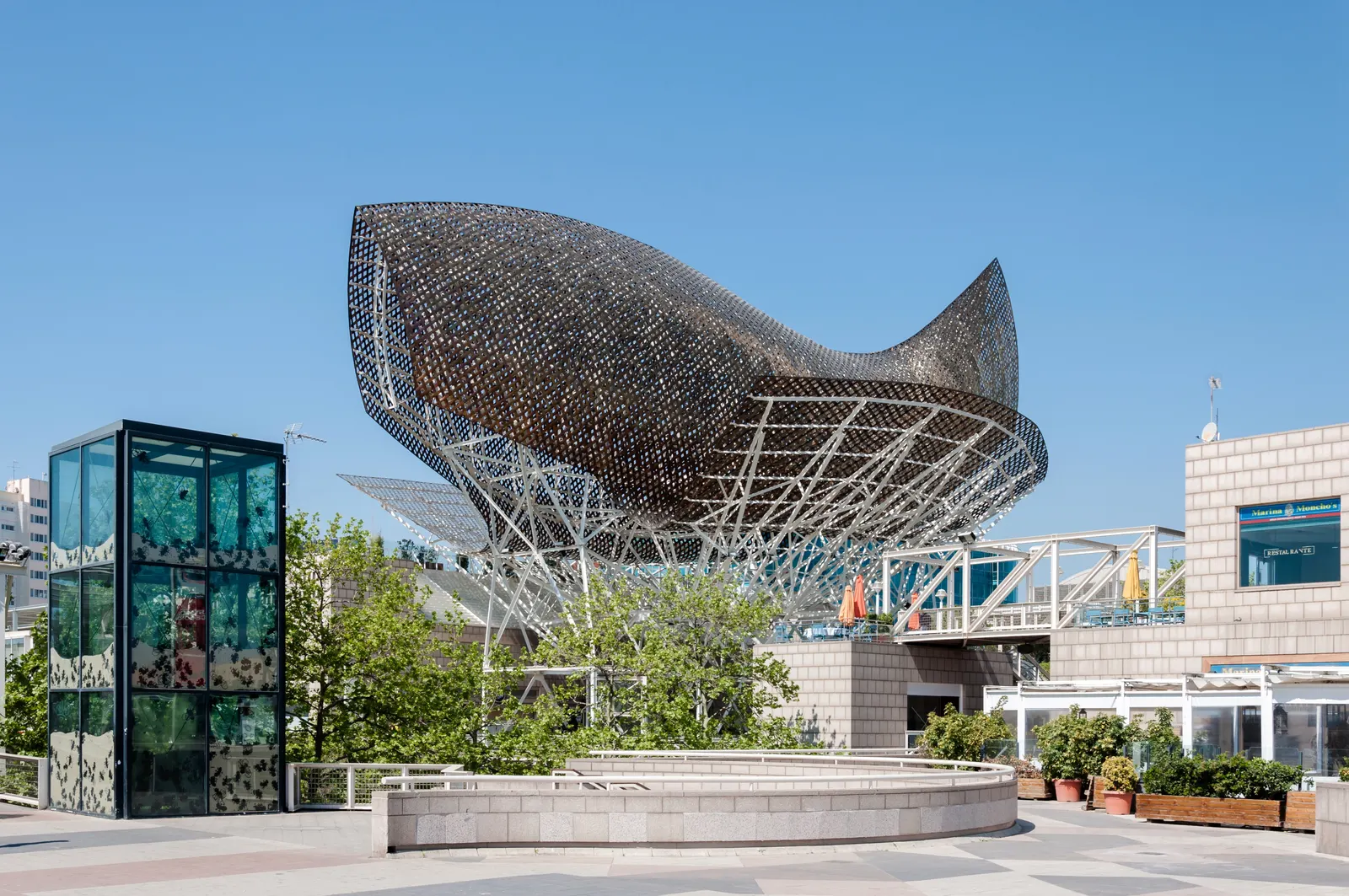
That is how Gehry put it, in the line that opens Gagosian's 2013 press release. Since the first lamp, the gallery notes, the fish has recurred in his work: in the curves of the Guggenheim Museum in Bilbao, the Jay Pritzker Pavilion in Chicago and the Marqués de Riscal hotel in Elciego, and in the giant fish sculpture at Barcelona's Vila Olímpica.
SFMOMA sees the lamps as an early statement of qualities that became central to Gehry's architecture: fluidity, buoyancy and the freedom of form that comes from separating skin and skeleton.
Back to laminate in 2012
Almost thirty years later Gehry returned to the material. In 2012, Gagosian reports, he began an entirely new group of fish lamps, from life-size to outsize, using the colour-core laminate more boldly, in larger and more jagged pieces; each lamp is unique and made by hand. The new series was shown at Gagosian in Beverly Hills, Paris and London in 2013 and in Hong Kong in 2014.
The early lamps are museum pieces. SFMOMA holds a Fish Lamp of 1983/2003, the Philadelphia Museum of Art one of about 1983, and the Jewish Museum in New York showed eight of them in 2010.
Venturi Scott Brown: ornament on laminate
Robert Venturi had answered Mies van der Rohe's 'Less is more' with 'Less is a bore', MoMA recalls. With Denise Scott Brown he applied the idea to furniture: MoMA's Queen Anne side chair of 1983 reduces an eighteenth-century form to a flat silhouette in bent maple plywood, covered in plastic laminate printed with their 'Grandmother' pattern — based, the museum explains, on a mass-produced floral tablecloth owned by the grandmother of one of their employees. The manufacturer, Knoll International, gave the chair to MoMA in 1984.
The Victoria and Albert Museum holds its sibling, the Chippendale chair of 1984, in laminated plywood with a plastic laminate surface — one of nine chairs in historical styles made for Knoll in the mid-1980s. The V&A says the chair has been celebrated for reintroducing decoration and historic form into contemporary furniture, and that it was collected for its notoriety and that of its designers.
What they saw in the material
The two projects use laminate in opposite ways. Gehry worked with what is inside the sheet — colour that runs right through it and light that passes into it. Venturi and Scott Brown worked with the face — a printed surface that can carry ornament, wit and memory as easily as a plain colour. Both treated an industrial panel as material worth an architect's full attention, and the museums agreed.
Reading this against the Rushil range
Rushil's TOPAZ catalogue shows seven core colours beside its construction diagram — Crystal, Silver, Quartz, Anthracite, Carbon, Noir and Natural — so the core of a compact panel need not be black; ask which are available for the decor and thickness you need. For printed surfaces, the decorative HPL range runs from 0.5 to 1.8 mm, and the Rushil collections on this site include 445 decors.
Common questions
What material did Frank Gehry use for his fish lamps?
A colour-core plastic laminate launched in 1983, whose colour runs through the sheet. When Gehry broke a piece, it fragmented into translucent, scale-like shards, which he glued onto wire armatures (SFMOMA, the Jewish Museum).
Where can Gehry's fish lamps be seen?
In the collections of SFMOMA and the Philadelphia Museum of Art. The Jewish Museum in New York showed eight in 2010, and Gagosian exhibited a new series in Beverly Hills, Paris, London and Hong Kong in 2013–14.
Which Venturi Scott Brown chairs are covered in laminate?
Their series of chairs in historical styles for Knoll, including the Queen Anne side chair of 1983 at MoMA and the Chippendale chair of 1984 at the V&A, both with a plastic laminate surface printed with the 'Grandmother' pattern.
Sources
- SFMOMA — Frank O. Gehry, Fish Lamp, 1983/2003en
- Philadelphia Museum of Art — Frank Gehry, Fish Lamp, c. 1983en
- The Jewish Museum, New York — Fish Forms: Lamps by Frank GehryJan 1, 2010 · en
- Gagosian — Frank Gehry: Fish Lamps — press release, LondonOct 23, 2013 · en
- The Museum of Modern Art — Robert Venturi, Denise Scott Brown. Queen Anne Side Chair. 1983en
- Victoria and Albert Museum — Chippendale Chair with Grandmother patternen
- The Pritzker Architecture Prize — Frank Gehry — 1989 Laureateen
- The Pritzker Architecture Prize — Robert Venturi — 1991 Laureateen
Compiled for this site from the publications listed above. Summaries are in our own words, not quotations — read the originals for the full argument.