In short
- Settle panel length first: compact panels up to 4330 mm cover most kitchen runs in one piece. Then choose thickness, which sets both the span and the edge.
- TOPAZ is tested for food contact: overall migration to EN 1186 stays within the 10 mg/dm² limit in all three migrations, and melamine was not detected.
- The surface is non-porous and needs no sealing; it returns the top grade for dry heat at 160 °C, and its flexural strength is 136.1 MPa against a required 80.
Start with panel length, not thickness
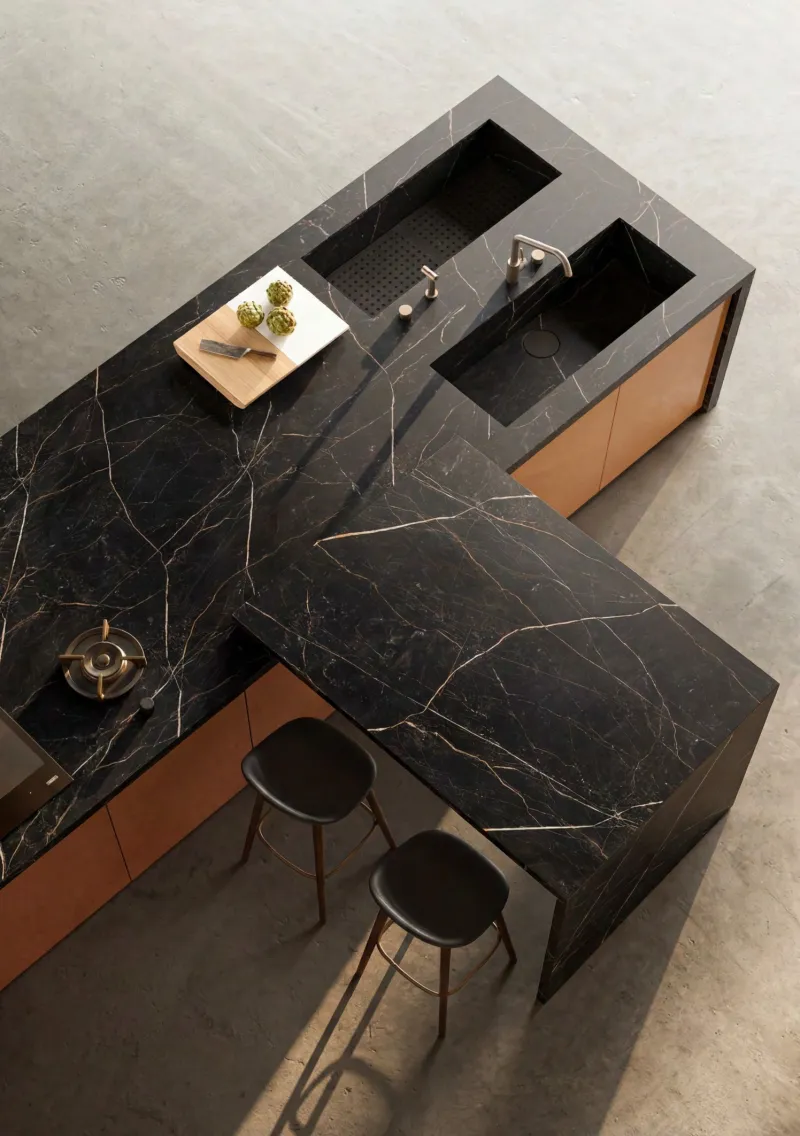
The first decision is where the joints go, and panel length decides that. A worktop run longer than the available panel has a joint in it, and the position of that joint is a design decision that should be made deliberately rather than discovered on site.
Compact panels reach 4330 mm in the large formats, which covers most domestic and much commercial runs in a single piece. Working back from the longest uninterrupted run in the drawing is a faster route to the right format than working forward from a price list.
Then thickness, because it drives the edge
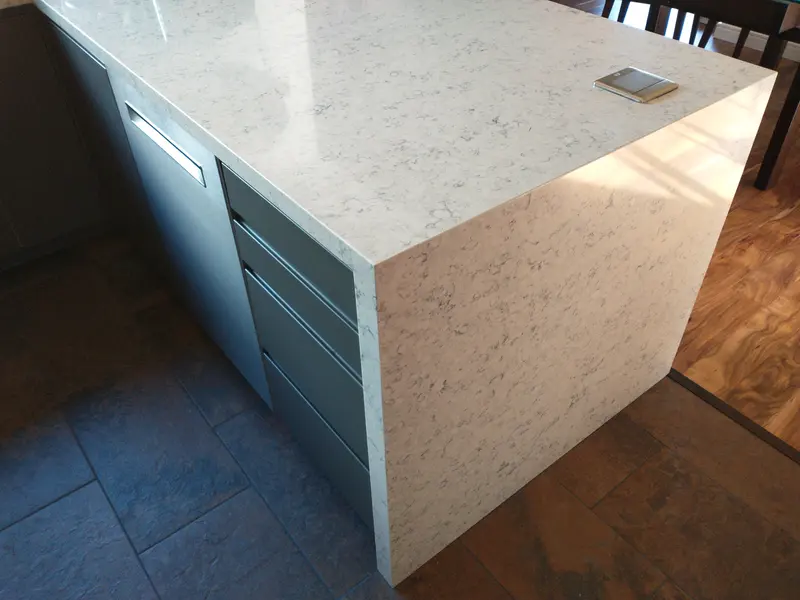
Thickness in a compact worktop is doing two jobs: carrying the span between supports, and producing the edge profile. A 12 mm panel and a 20 mm panel read completely differently at the edge, and the visual decision and the structural one are the same decision.
Where a thin edge is wanted over a longer span, the usual answer is a thinner panel on a continuous substructure rather than a thicker panel spanning further. That keeps the sightline and moves the load into the carcass.
Food contact: ask what was tested, not whether it is safe
For a kitchen surface the useful question is which tests were run and against which standard, not whether the product is described as food safe.
Overall migration to EN 1186 is reported at 9.06, 3.07 and not detected across three successive migrations, against a permitted limit of 10 mg/dm². Specific migration testing to EN 13130-1 covers melamine, bisphenol A, phenol, phthalates, formaldehyde and primary aromatic amines. The TOPAZ data sheet reports all six as not detected. The SGS laboratory reports behind Rushil's food-contact summary give the detail: melamine was not detected in any of three successive migrations, against a limit of 2.5 mg/kg, and formaldehyde measured 5.31 and 4.29 mg/kg in the first two and was not detected in the third, against 15 mg/kg. Sensory examination to DIN 10955 returned a score of 0 for both odour and taste against a permissible 2.5 — relevant because a surface that taints food fails in a kitchen regardless of its chemistry.
Confirm that this testing covers the decor and finish you intend to specify. Testing is carried out on samples, and a range is not automatically covered end to end.
Heat, and what the 160 °C figure means
Resistance to dry heat is tested at 160 °C to EN 438-2.16, and the compact grades return the top appearance grade. This is a laboratory condition — a defined heat source, a defined duration, an assessment of appearance afterwards.
It is not a statement that cookware can be placed directly on the surface. A pan off a hob is hotter than 160 °C and delivers that heat through a small contact area for an uncontrolled time. Trivets remain part of the specification, and it is worth writing that into the handover documentation rather than leaving it to the end user to discover.
The mechanical numbers that matter
Three figures do most of the work in a worktop calculation. Flexural strength of 136.1 MPa against a required 80 sets what the panel can span. A modulus of elasticity of 15 336 MPa against a required 9 000 sets how much it deflects before it gets there — usually the governing figure, because a worktop that visibly sags has failed even though nothing broke. Screw pullout of 3 514 N sets fixing centres for the substructure.
Common questions
How thick should a compact kitchen worktop be?
Compact worktop panels are commonly specified from 10 mm upward, with the choice driven by span between supports, the edge profile wanted and the substructure. There is no single correct figure — deflection over the longest unsupported span usually decides it.
Can a compact worktop be joined invisibly?
Joints in compact are mechanical, not welded, so a joint is always detectable on close inspection. The practical approach is to place joints deliberately — at a change of direction, under an appliance — and to choose a panel length that keeps them out of the primary sightline.
Do compact worktops need sealing?
No. The surface is non-porous and requires no sealing or periodic treatment. Cleaning is warm water and a neutral detergent; abrasive powders and strongly acidic or alkaline products damage the surface.
Written for this site from manufacturer test reports. Not reproduced from any other source.